

Healthcare Digital Transformation Using IoT
Murale Narayanan, Director - Global Competency, DELL EMC
The Internet of Things(IoT)is increasingly gaining popularity in the 21st century and is correctly perceived as the key focus area of growth by the leading global enterprises. It’s a concept which has the in-definite potential to impact our lives; both in home & office. This paper aims at emphasizing why every CIO should see and adopt it as their key to success, by quoting how IoT can transform the healthcare industry. This paper discusses the evolution, architecture, application, benefits, and current trends& challenges in the use of IoT in healthcare industry. The healthcare industry in the 21st century has been increasingly becoming unaffordable, unreliable and slow due to ever increasing numbers of patients & diseases. There is a lack of awareness & guidelines for the best possible use of IoT in healthcare. Connected patients, physicians and hospitals powered by IoT not only optimize this industry, but also can trigger growth.
This paper starts with introduction & evolution of IoT; showing how the term IoT was first quoted by Kevin Ashton in 1999, and the journey from RFIDs to IoT via WSN and Smart Things. This paper then explains the IoT Healthcare Network; consisting of Topology, Architecture and Platform. A typical IoT topology comprises of sensore quipped edge devices on a wired or wireless network transmitting the data via one gateway which is a public or private cloud. In IoT architecture, there are three primary parts: sensors, network connectivity and the data storage applications; and the IoT architecture can have multiple stages. The Platform consists of libraries, framework and environment.
This paper then talks about IoT Healthcare Services & Applications. The IoT services are used to create IoT applications which are used by the users & patients directly. Hence the services are developer centric, while the applications are user centric. This paper proposes some of the healthcare services which can be provided with the use of IoT, for example, ambient-assisted living, the internet of m-Health thing (m-IoT), children health
information, wearable device access, and many more. IoT ensures that these services are easy to deliver, fast, secure and low cost. This paper then explains how IoT can be divided between Single vs. Clustered applications; depending upon its use to monitor a single disease or group of diseases This paper also lists various applications and sensors available in the market, which can be used for Blood Pressure, Sugar, Body Temperature, Heart Rate and many other monitoring.
This paper then focuses on current status and trends of the IoT in healthcare industry. It shows how IoT can bring higher ROI for the capitalists when compared to traditional healthcare. It also talks about how new startups are using IoT to gain market share especially using smartphone apps. This paper then lists some of the smartphone apps used in IoT healthcare, and shows how the well-known MNCs like Google, IBM, Microsoft, CISCO, Samsung, Qualcomm and Intel have already jumped into the game.This paper then discusses the very important issue of Security in the use of IoT in healthcare industry. It emphasizes the fact that IoT devices carry sensitive personal medical information; and the need for its security over the connected global information networks, while it can be accessed at any time at any place. It lists the security requirements and challenges in meeting those requirements using traditional techniques. This paper then makes the users aware of the possible internal & external threats and how they can possibly affect the IoT healthcare due to limitations in current technologies.
At last but not the least, this paper talks about the technologies which are used for the IoT based healthcare solutions. It discusses the use of Cloud Computing, Big Data and Analytics, Networks and Wearable Devices.
With the global IoT healthcare market likely to reach over $6.93 billion by the year 2020, industrial IoT could be a game changer for the healthcare industry. From health & fitness monitoring to wellness sensors to surgical robots & smart hospitals, IoT is bringing in new, unique and innovative tools in the ecosystem leading to integrated healthcare for the masses.
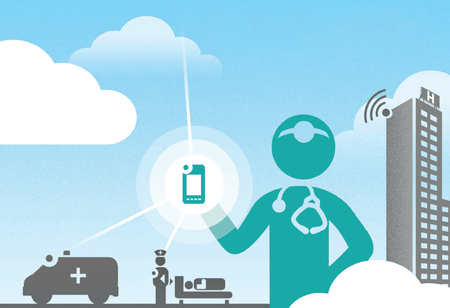
With IoT, companies can reorganize and revolutionize patient healthcare. With increasing dependency on technology, the IoT offers convenience and economic solutions for both patients and healthcare professionals.
With Increasing Dependency On Technology, The IoT Offers Convenience And Economic Solutions For Both Patients And Healthcare Professionals
This paper then focuses on current status and trends of the IoT in healthcare industry. It shows how IoT can bring higher ROI for the capitalists when compared to traditional healthcare. It also talks about how new startups are using IoT to gain market share especially using smartphone apps. This paper then lists some of the smartphone apps used in IoT healthcare, and shows how the well-known MNCs like Google, IBM, Microsoft, CISCO, Samsung, Qualcomm and Intel have already jumped into the game.This paper then discusses the very important issue of Security in the use of IoT in healthcare industry. It emphasizes the fact that IoT devices carry sensitive personal medical information; and the need for its security over the connected global information networks, while it can be accessed at any time at any place. It lists the security requirements and challenges in meeting those requirements using traditional techniques. This paper then makes the users aware of the possible internal & external threats and how they can possibly affect the IoT healthcare due to limitations in current technologies.
At last but not the least, this paper talks about the technologies which are used for the IoT based healthcare solutions. It discusses the use of Cloud Computing, Big Data and Analytics, Networks and Wearable Devices.
With the global IoT healthcare market likely to reach over $6.93 billion by the year 2020, industrial IoT could be a game changer for the healthcare industry. From health & fitness monitoring to wellness sensors to surgical robots & smart hospitals, IoT is bringing in new, unique and innovative tools in the ecosystem leading to integrated healthcare for the masses.
With IoT, companies can reorganize and revolutionize patient healthcare. With increasing dependency on technology, the IoT offers convenience and economic solutions for both patients and healthcare professionals.