

How Technology Is Closing The Gap In Senior Healthcare?
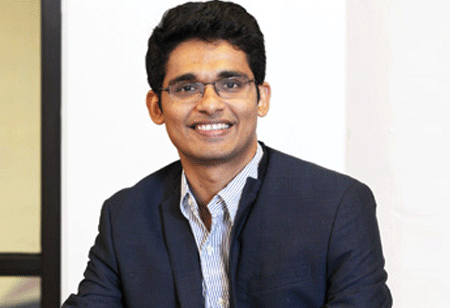
Sushant Reddy, Co-Founder & CEO, Arvi, 0
We have just celebrated our entry into a new decade. The defining theme of the first two decades of this century is the rise of technology startups and the transformative change technology has brought to our lives. Just 10 years back, none of us could have imagined the lifestyle changes created by the likes of companies such as Uber, Amazon, Swiggy or Netflix. However, there are some industries where technology hasn’t had such a transformative effect yet. One such industry is healthcare and more specifically, healthcare for senior citizens.
What is senior healthcare?
‘Senior healthcare’ in itself is a very generic term in fact the term is so generic that everything from OPD to hospital care to pharmacy can be grouped into this category. Broadly speaking, senior healthcare can be classified into four areas –
Hospital Care:This is what everyone easily relates to as 'traditional healthcare'. Episodic events such as emergencies, illness, and injury treatments at a hospital come under‘hospital care’.
Preventive Care:All aspects of healthcare that are preventive in nature such as diagnostic tests, pharmacy, doctor consultations, disease management (diabetes, hypertension), and insurance fall into ‘preventive care’.
Home Care:All healthcare services delivered at home such as nursing, physiotherapy, home ICU, dialysis & chemo therapy services at home, and medical devices come under 'home care'.
Healthy Living: All services that enable a healthy lifestyle for seniors such as 'custom designed senior homes', smart tracking devices, and companionship services come under ‘healthy living’.
Why is senior healthcare a massive challenge?
India is in the middle of a rapid demographic and cultural transition. Senior citizens above 60 years are over a 100 million today and constitute eight percent of the total population. This figure is expected to grow to 350 million(estimated 20 percent of total population) by 2050, a dramatic rise in older population, both in size and proportion.
Another massive factor driving this transition is a mass migration, both domestic and international of Indian millennials that happened during the 80s, 90s and first decade of 21st century. India has recorded over 30 million international migrants and 139 million domestic migrants as of 2017.
Why did technology have limited success so far?
Technology has not yet created a disruptive impact in
senior healthcare industry because of two main reasons –
Fragmented & Localized Service Providers: Traditionally, senior healthcare services have been very 'human intensive'. Role of care provider was extremely critical, and everything else was not a deal breaker.
Low Tech-savviness of Seniors: All things equal, technology adoption of millennials is much higher than that of senior citizens. While seniors are comfortable with popular apps like Whatsapp and Youtube, adoption of other technology in general has been less than spectacular.
Language Barriers: English is not a preferred conversational medium for most senior citizens. Most technology platforms are designed for urban, english speaking customer. This becomes a major mental obstacle not only for senior citizens, but also care providers.
How can technology transform senior healthcare?
There are multiple areas where technology can become a real force multiplier. Here are a few use cases –
Smart Medical Alert System: India does not have a reliable 911 emergency service that can be accessed by senior citizens. Having smart medical alert systems that can provide medical support on a push of a button will be a great value-add for seniors.
Doctor-On-Call Services: Senior citizens usually avoid visiting a doctor for minor health issues because of mobility & logistic issues. A ‘doctor-on-call’ service where general physicians and specialist doctors can talk over a voice/video call will be a great value proposition for senior citizens.
IoT Devices & Smart Tracking: Oenior citizens have a higher risk of falls, rapid heart rate, breathlessness, and low BP. Smart devices that can track regular health vitals, detect abnormal patterns and alert care providers is another major opportunity in this space.
Smart Senior Living Homes: Concept of senior living was a social taboo until recently. With realty developers revisiting the concept of ‘senior living’, a lot of Indians are taking a fresh look at this concept.
Intelligent Voice Platforms: Voice is a major breakthrough when it comes to senior citizens. Easy, intelligent voice-based platforms to order medicine and, schedule doctor appointments or health checkups will be a major opportunity in future.
Conclusion
Technology has not been a disruptive force in senior healthcare, but that story is set to change over the next 5-6 years. With rapid advances in voice enabled platforms, artificial intelligence and IoT devices, a wave of startups are 'burning' midnight oil to come up with smart easy-to-use technological solutions that create an impact in the senior healthcare industry. It is not a question of ‘if’ anymore, it’s just the ‘when’ that needs to be answered.
Fragmented & Localized Service Providers: Traditionally, senior healthcare services have been very 'human intensive'. Role of care provider was extremely critical, and everything else was not a deal breaker.
Low Tech-savviness of Seniors: All things equal, technology adoption of millennials is much higher than that of senior citizens. While seniors are comfortable with popular apps like Whatsapp and Youtube, adoption of other technology in general has been less than spectacular.
Language Barriers: English is not a preferred conversational medium for most senior citizens. Most technology platforms are designed for urban, english speaking customer. This becomes a major mental obstacle not only for senior citizens, but also care providers.
Most technology platforms are designed for urban, English speaking customer, which becomes a major mental obstacle not only for senior citizens, but also care providers
How can technology transform senior healthcare?
There are multiple areas where technology can become a real force multiplier. Here are a few use cases –
Smart Medical Alert System: India does not have a reliable 911 emergency service that can be accessed by senior citizens. Having smart medical alert systems that can provide medical support on a push of a button will be a great value-add for seniors.
Doctor-On-Call Services: Senior citizens usually avoid visiting a doctor for minor health issues because of mobility & logistic issues. A ‘doctor-on-call’ service where general physicians and specialist doctors can talk over a voice/video call will be a great value proposition for senior citizens.
IoT Devices & Smart Tracking: Oenior citizens have a higher risk of falls, rapid heart rate, breathlessness, and low BP. Smart devices that can track regular health vitals, detect abnormal patterns and alert care providers is another major opportunity in this space.
Smart Senior Living Homes: Concept of senior living was a social taboo until recently. With realty developers revisiting the concept of ‘senior living’, a lot of Indians are taking a fresh look at this concept.
Intelligent Voice Platforms: Voice is a major breakthrough when it comes to senior citizens. Easy, intelligent voice-based platforms to order medicine and, schedule doctor appointments or health checkups will be a major opportunity in future.
Conclusion
Technology has not been a disruptive force in senior healthcare, but that story is set to change over the next 5-6 years. With rapid advances in voice enabled platforms, artificial intelligence and IoT devices, a wave of startups are 'burning' midnight oil to come up with smart easy-to-use technological solutions that create an impact in the senior healthcare industry. It is not a question of ‘if’ anymore, it’s just the ‘when’ that needs to be answered.