

Innovative Financing to Make Smart Cities Climate-Proof
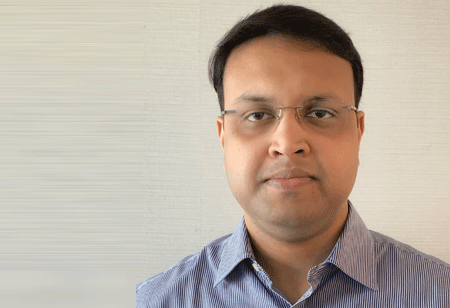
Ajeya Bandyopadhyay (Partner) & Dr. Amrita Ganguly (Associate Director), KPMG, 0
According to UN-Habitat’s estimates, over 64 percent of the world’s population is expected to reside in cities by 2050. Cities consume enormous resources. As per IPCC, urban infrastructure accounts for two-third of the global energy use and 70 percent of energy related to Green House Gas (GHG) emissions. By 2025, megacities of 10 million or more people will house more than half the world’s population and contribute more than half of global GDP.
As India’s urban population grows from 410 million in 2014 to 814 million in 2050, with about seven cities having more than 10 million population, so will there be growing consumption of energy and material resources, problems of water supply, environmental degradation and management of solid wastes. This gets further aggravated by growing risks of climatic shocks and vulnerability; increased frequency of floods, cyclones, extreme temperature and heat waves; disrupting city lives and affecting the poor who typically lack adequate resources and safeguards to fight such stresses. The size & scale of such damages are enormous. The Economist reports that ‘2011 Bangkok flood caused estimated damages of $45 billion to the global supply chain of which only 10 billion was insured’.
Fundamentally climate-smart transformation needs a set of city-specific strategies to systematically reduce city’s carbon footprint and enhance its resilience to climate change impact through smart, affordable, and resilient infrastructure, and mixed form of adaptable land use. Cities need to assess the potential risks of climate vulner-abilities (erratic rainfalls, flood, high temperature), and monetize those risks to account for additional financial and social costs for building safeguards. Each city should have a clearly defined ‘low carbon and resilient pathway’ - a series of interventions under certain plausible scenarios around energy efficient utilities, rooftop solar and battery storages, e-mobility, green and affordable building, smart grids and many more - that decouples city’s economic growth from the growth of GHG emissions.
The funding needed to achieve such transformation is unprecedented. South Asian cities would need around $2.5 trillion investments till 2030 to become ‘low carbon and climate resilient’. Approximately, 88 percent of this investment would be needed in buildings and construction sector alone, followed by 0.5 percent in waste sector, 1.7 percent in public transport, 2 percent in renewable energy, 3 percent in climate-smart water and 4 percent in electric vehicles.
On the other hand, financing climate-smart cities are always a challenge that needs innovative solutions. The ability of cities to finance urban infrastructure largely depends on their budgets, revenue sources and creditworthiness. The perceived lack of creditworthiness (among 500 largest emerging market cities, only four percent are creditworthy) for most cities in India become critical barriers to secure affordable financing on international market or issue bonds. Credit enhancement facilities, such as Guarantee Fund and other risk sharing instruments, can help cities to overcome such barrier and raise funds by issuing bonds and by others means.
Another effective way to catalyze private investment in urban projects is to mobilize credits through local financial institutions (LFIs) who are perhaps better
positioned to assess and manage the risks inherent to the local authorities, and mobilize medium & long term financing in local currencies, thus eliminating the forex risk. They typically offer longer tenor lengths that suit climate projects with longer payback period. Projects, such as microgrids, bundled energy efficiency in water pumping, or waste-to-energy, having smaller deal sizes make them a better fit for local financial institutions which are having smaller investment appetite. However, to maximize the development impact, the LFIs while disbursing credits should ensure appropriate Environment Social Governance (ESG) safeguards.
More importantly, to attract investments, cities should develop a pipeline of ‘bankabale’ projects that meet broad feasibility parameters. Project preparation is expensive, typically accounts for 5-10 percent of the project’s cost, and most cities lack adequate capacity for conducting feasibility, design, and financial structuring of the projects. This is where development partners, equipped with global best-practices and tools, can step into support cities in setting project selection criteria, design standards and procurement guidelines to favour climate-smart infrastructure, laying right indicators for monitoring, and building capacity to accelerate city ability to develop high-quality, investor-friendly projects.
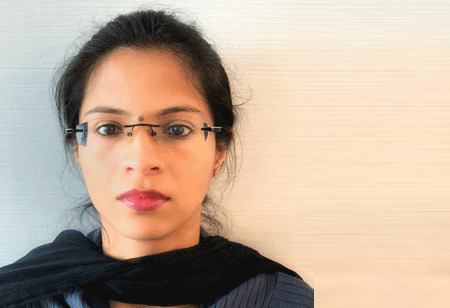
Dr. Amrita Ganguly(Associate Director)
Beyond traditional approaches, more and more cities are leveraging international partnerships, networks and platforms like Asian Cities Climate Change Resilience Network (ACCCRN), C40 Cities, Covenant of Mayors, CityNet Secretariat in order to build strategic partnerships between cities. These networks often become instrumental in addressing the whole spectrum of the critical urban finance gap by (a) building awareness among stakeholders on investment needs concerning climate actions in city areas, (b) supporting the development of high-quality bankable low carbon and resilient infrastructure projects, and (c) mobilizing financial resources at a massive scale from banks, institutional investors and private donors, and fostering new approaches for fund raising for credit enhancement and technical assistance for climate projects.
In any smart and future ready city new solutions will evolve from the nextgen startups and technopreneurs. This Incubation Centre could support entrepreneurs to come up with innovative technologies and business models that are scalable across city and have a sustainable/climate smart dimension. The city can setup an ‘Innovation Fund’ to provide seed funding to support and promote such startups. Transformative change is needed now in how we build, operate and manage cities and several urban services which they provide. The need is urgent, the time frame for making the choice is critical due to ‘lock-in’ effect of capital and technology. The challenge is not simply to increase the volume of funding in the pipeline, but also to create an enabling environment to catalyze new finance flow from a broad spectrum of investors public or private. Regulators need to create a more consistent and supportive regulatory environment ensuring that green infrastructure is not automatically gets characterized as highrisk investment, and there exists a clear framework for private public partnerships.
Transformative change is needed now in how we build, operate and manage cities and several urban services which they provide
More importantly, to attract investments, cities should develop a pipeline of ‘bankabale’ projects that meet broad feasibility parameters. Project preparation is expensive, typically accounts for 5-10 percent of the project’s cost, and most cities lack adequate capacity for conducting feasibility, design, and financial structuring of the projects. This is where development partners, equipped with global best-practices and tools, can step into support cities in setting project selection criteria, design standards and procurement guidelines to favour climate-smart infrastructure, laying right indicators for monitoring, and building capacity to accelerate city ability to develop high-quality, investor-friendly projects.
Dr. Amrita Ganguly(Associate Director)
Beyond traditional approaches, more and more cities are leveraging international partnerships, networks and platforms like Asian Cities Climate Change Resilience Network (ACCCRN), C40 Cities, Covenant of Mayors, CityNet Secretariat in order to build strategic partnerships between cities. These networks often become instrumental in addressing the whole spectrum of the critical urban finance gap by (a) building awareness among stakeholders on investment needs concerning climate actions in city areas, (b) supporting the development of high-quality bankable low carbon and resilient infrastructure projects, and (c) mobilizing financial resources at a massive scale from banks, institutional investors and private donors, and fostering new approaches for fund raising for credit enhancement and technical assistance for climate projects.
In any smart and future ready city new solutions will evolve from the nextgen startups and technopreneurs. This Incubation Centre could support entrepreneurs to come up with innovative technologies and business models that are scalable across city and have a sustainable/climate smart dimension. The city can setup an ‘Innovation Fund’ to provide seed funding to support and promote such startups. Transformative change is needed now in how we build, operate and manage cities and several urban services which they provide. The need is urgent, the time frame for making the choice is critical due to ‘lock-in’ effect of capital and technology. The challenge is not simply to increase the volume of funding in the pipeline, but also to create an enabling environment to catalyze new finance flow from a broad spectrum of investors public or private. Regulators need to create a more consistent and supportive regulatory environment ensuring that green infrastructure is not automatically gets characterized as highrisk investment, and there exists a clear framework for private public partnerships.