

The New MBA - Management by AI
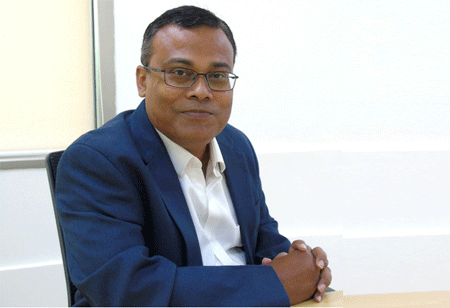
Soumendra Mohanty, EVP & CDAO, LTI
Today, the transformative potential of Artificial Intelligence (AI) is obvious. Whether you come across it from a distance or experience it upclose, this disruptive technology is poised to reorient the workforce, revamping not only the easy-to-automate tasks, but also complex jobs where judgment skills are required.
In context of the global business landscape, where CXOs have always practiced the age-old mantra ‘empowered people are the key to the success of an organization’, this unprecedented technological trend is giving rise to a new reality ‘autonomous smart algorithms are the key to success’, which is emerging in a not so distant horizon. This leaves modern organizations no choice but to value empowered algorithms as much as they had valued empowered people.
With AI in the Mix, the management model which involved practices that shaped the very culture and way-of-working in the company which till date were governed, changed and enforced keeping predominantly human workforce in mind will need to undergo dramatic changes. All three facets of the organization’s business model(the what, the why and the how) will require an overhaul in an AI-Future.
In the traditional business model, CXOs are likely to get advice from industry experts and topnotch consulting companies to strategize and stay prepared for nearterm, shortterm and longterm impacts as well as for creating newrevenue generating opportunities. However, in the Digital age, organisations can’t apply the same principles because it is increasingly becoming a VUCA (volatility, uncertainty, complexity, and ambiguity) situation for every business. A business strategy, in the older world, drawn at the beginning of a financial year was perhaps “good enough” to sail through the entire year. However, in the Digital world, this definition of “good enough” is being challenged every passing day.
Organisations today need algorithms that can constantly carry out data driven checks, gather external intelligence and recommend optimal courses of action, often times challenging the earlier drawn strategy and action items with contrarian point of views. Besides doing the analysis and providing recommendations at a holistic level, the algorithms can also double up to play a virtual AI assistant role to respective function heads in organizations, and provide deeper analysis and specific recommendations for their areas.
Businesses are run by a complicated orchestration of business processes,systems, interfaces, applications and people. Even with advancements in technology
earlier in the traditional model the functional owners and managers always managed processes and systems and were responsible for various decisions. Because of this over dependence on the human-in-the-loop, businesses are becoming unresponsive to the fast pace of the Digital age.
AI solutions today are solving far more complex problems and can play an effective role in running a company’s business processes and systems in an autonomous manner. For AI to function as a business process optimizer in an effective manner, organisations need to have clear task descriptions, service level agreements, key performance measures and expected outcomes. Any ambiguity would lead the AI to result in wrong outputs or worst, no action at all.
Talent, especially in technology is fleeting. The pace of change in technology is making skills irrelevant every passing day. Even the most talented employees are facing the brunt because of the agile business environment going through rapid experimentation. In such scenarios, employees are in desperate need of an AI virtual assistant which can guide them and work with them in a collaborative way.
Combining the prediction capabilities of AI and the judgement skills of human brings in sea change improvements to the way organizations works. As AI will need human involvement to improve its prediction accuracy, humans will need a multitude of recommendations from AI to make the judgement call. This mutually beneficial man machine collaboration will improve the efficiency of employees as well as of the virtual assistant, consequently improving the overall performance of the organization.
CXOs are empowered to steer the company to new levels of profitability and innovation. Today, theydo these tasks by sheer hard work, commitment, passion. But, there is always a risk of what they are deciding on and what they are leaving out, and if things go wrong, organizations are still left with some time on hand to pursue course corrections. However, in the digital age, if every business is implementing the above three imperatives earnestly and running at machine pace, the challenge will be magnified and the time to react and change will be virtually non-existent.
This will necessitate every CXO to have an AI companion to make autonomous decisions and match the speed of the machine.
The four radical approaches of incorporating AI into management model, no doubt will make the AI systems much more learned than when they were trained in labs. Is the same expected out of humans, that by effectively collaborating with AI they will reach super-human powers! Why not? For that to happen, the humans need to start trusting the machines and as the prediction powers of machines continues to advance, perhaps the increased oversight of humans will turn to additional insights.
Combining the prediction capabilities of AI and the judgement skills of human brings in sea change improvements to the way organizations works
AI solutions today are solving far more complex problems and can play an effective role in running a company’s business processes and systems in an autonomous manner. For AI to function as a business process optimizer in an effective manner, organisations need to have clear task descriptions, service level agreements, key performance measures and expected outcomes. Any ambiguity would lead the AI to result in wrong outputs or worst, no action at all.
Talent, especially in technology is fleeting. The pace of change in technology is making skills irrelevant every passing day. Even the most talented employees are facing the brunt because of the agile business environment going through rapid experimentation. In such scenarios, employees are in desperate need of an AI virtual assistant which can guide them and work with them in a collaborative way.
Combining the prediction capabilities of AI and the judgement skills of human brings in sea change improvements to the way organizations works. As AI will need human involvement to improve its prediction accuracy, humans will need a multitude of recommendations from AI to make the judgement call. This mutually beneficial man machine collaboration will improve the efficiency of employees as well as of the virtual assistant, consequently improving the overall performance of the organization.
CXOs are empowered to steer the company to new levels of profitability and innovation. Today, theydo these tasks by sheer hard work, commitment, passion. But, there is always a risk of what they are deciding on and what they are leaving out, and if things go wrong, organizations are still left with some time on hand to pursue course corrections. However, in the digital age, if every business is implementing the above three imperatives earnestly and running at machine pace, the challenge will be magnified and the time to react and change will be virtually non-existent.
This will necessitate every CXO to have an AI companion to make autonomous decisions and match the speed of the machine.
The four radical approaches of incorporating AI into management model, no doubt will make the AI systems much more learned than when they were trained in labs. Is the same expected out of humans, that by effectively collaborating with AI they will reach super-human powers! Why not? For that to happen, the humans need to start trusting the machines and as the prediction powers of machines continues to advance, perhaps the increased oversight of humans will turn to additional insights.