


Rajinder Kumar Malhotra : A People-First Leadership Legacy
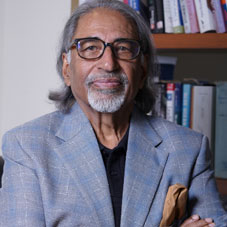
Rajinder Kumar Malhotra
Former Group CEO
RKM began his career with the Ford Foundation project at the Indian Agricultural Research Institute, before joining Indofil Industries in 1973. At Indofil, the company initially focused on domestic brand building as a subsidiary of Rohm & Haas. In 1994, RKM became CEO of Indofil, then a ₹130 crore company. By 2020, it had grown into a ₹2,300 crore enterprise with a presence in over 100 countries.
By embedding innovation, sustainability, and collaboration into the Group’s culture, he created a legacy of growth with responsibility in all Group businesses, i.e., Agro & Specialty Chemicals, Tobacco, cosmetics, Education and retail, trans -forming not only businesses but also the communities they touched.
We are excited to chat one-on-one with RKM; he shares his journey, leadership style, and more.
How would you describe your leadership style, and how has it evolved?
My style isn’t unique it evolved through experience. Starting as a sales representative gave me insight into frontline challenges. As I moved up to regional manager and divisional head, I understood the needs of teams at different levels. Working closely with K.K. Modi for 27 years was pivotal. He encouraged continuous learning, trying new ideas, and adopting external knowledge.
Guidance from Professor Ram Charan further shaped my approach. We introduced cross-functional teams and Joint Practice Sessions that decentralized decision-making, ensured transparency by sharing data in advance, and cut meeting times from day-long to just an hour or two. I define my leadership as collaborative, practical, and people-centered, grounded in real experience, reinforced by mentorship, and supported by systems that empower teams.
How do you foster participation and collabo - rative decision making?
Teamwork thrives when people are placed where their natural strengths shine. Inspired by K.K. Modi and Professor Charan, I aligned people to the right roles and encouraged continuous learning, including global exposure at Harvard Business School. I introduced four principles: transparency, targets (common goals), trust, and togetherness.
These created an environment where both success and failure were shared, and people felt engaged rather than judged. My focus has always been on nurturing potential, fostering ownership, and building moti- vated teams committed to long-term success.
What are your views on sustainability, particularly in CSR?
Our CSR focus was education, including scholarships for deserving students. But beyond formal CSR, the Group emphasized care and humanity. For example, when an employee faced a terminal illness, the company covered all medical expenses, even outside policy. I recall one executive undergoing a liver transplant 35 years ago; the company bore the full cost. This approach, rooted in K.K. Modi’s belief that the Group must stand by its people in times of need, built a culture that was both demanding and deeply humane. Many employees stayed because they felt genuinely cared for.
How did you encourage employees to participate in such initiatives?
In the agro-industry, one impactful initiative was village adoption. It went beyond farming, introducing best agri -cultural practices, working with fertilizer companies, engaging NGOs, and addressing sanitation and community welfare. For instance, in West Bengal, our managers adopted villages and collaborated with industry partners and social organi -zations, leading to holistic improvements in villagers’ lives. Village adoption was always a collective effort, not a solo initiative.
What are the key lessons from scaling a company?
When I became CEO, Indofil was a domestic company with a small team and limited products. We redefined our vision and recruited experienced mid-level managers and consultants with global expertise, enabling us to enter markets in Europe, Latin America, and beyond.
We invested in R&D, developing new patented products, took distribution rights of patented products of other companies from Japan, Korea and Israel, and established four worldclass plants in Gujarat with a total investment of ₹1,200 crore, including a joint venture with a Chinese company for carbon disulfide production and multi product specialty chemical facilities. These efforts created jobs, boosted sales, and enhanced profit ability. The keys to scaling were strategic partnerships, infrastructure invest- ment, and focused inter- national expansion.
You are actively engaged in writing. What are your current projects?
My ongoing project, The Journey of the Salesman: Journey Continues, reflects on my journey and the people who influenced me. My first book, Aise Hee, published recently, features 50 Hindi poems with English translations. All proceeds go to charity, and it is available on Amazon.
My ongoing project, The Journey of the Salesman: Journey Continues, ref -lects on my journey and the people who influenced me
What are your views on sustainability, particularly in CSR?
Our CSR focus was education, including scholarships for deserving students. But beyond formal CSR, the Group emphasized care and humanity. For example, when an employee faced a terminal illness, the company covered all medical expenses, even outside policy. I recall one executive undergoing a liver transplant 35 years ago; the company bore the full cost. This approach, rooted in K.K. Modi’s belief that the Group must stand by its people in times of need, built a culture that was both demanding and deeply humane. Many employees stayed because they felt genuinely cared for.
How did you encourage employees to participate in such initiatives?
In the agro-industry, one impactful initiative was village adoption. It went beyond farming, introducing best agri -cultural practices, working with fertilizer companies, engaging NGOs, and addressing sanitation and community welfare. For instance, in West Bengal, our managers adopted villages and collaborated with industry partners and social organi -zations, leading to holistic improvements in villagers’ lives. Village adoption was always a collective effort, not a solo initiative.
What are the key lessons from scaling a company?
When I became CEO, Indofil was a domestic company with a small team and limited products. We redefined our vision and recruited experienced mid-level managers and consultants with global expertise, enabling us to enter markets in Europe, Latin America, and beyond.
We invested in R&D, developing new patented products, took distribution rights of patented products of other companies from Japan, Korea and Israel, and established four worldclass plants in Gujarat with a total investment of ₹1,200 crore, including a joint venture with a Chinese company for carbon disulfide production and multi product specialty chemical facilities. These efforts created jobs, boosted sales, and enhanced profit ability. The keys to scaling were strategic partnerships, infrastructure invest- ment, and focused inter- national expansion.
You are actively engaged in writing. What are your current projects?
My ongoing project, The Journey of the Salesman: Journey Continues, reflects on my journey and the people who influenced me. My first book, Aise Hee, published recently, features 50 Hindi poems with English translations. All proceeds go to charity, and it is available on Amazon.
Currently, I’m working on two more books—one nearly complete, another halfway through. Writing and exploring music through AI and sharing creations on my YouTube channel (Aise Hee by Rahil) have become my main pursuits. I would also like to collaborate with startups to challenge conventional thinking and uncover fresh opportunities.
What inspired you to write The Journey of the Salesman – Journey Continues?
The idea came from two questions raised during a Harvard Business School program: 1. What is the contribution of others in your life? I realized that parents, teachers, colleagues, customers, and even competitors shaped me, sometimes by guiding, other times by challenging.
I believe more than 85 percent is the contribution of others in my journey. 2. What is your contribution to others’ lives? This humbled me deeply and pushed me to reflect on giving back to family, society and community, without expectation or recog - nition. These reflections became the foundation for my book.
What advice would you give aspiring young leaders?
My advice: embrace change and make learning a lifelong habit. The world is constantly shifting, technologically, socially, and geopolitically. To stay relevant, you must not just accept change but enjoy adapting to it. When learning brings joy, curiosity fuels growth, at any stage of life or career.
Rajinder Kumar Malhotra, Former Group CEO, Modi Enterprises
With over five decades of leadership across agriculture, chemicals, and other industries, Rajinder guided Modi Enter - prises to global growth through innovation, partnerships, and a people-first culture. He is also an author. His first book, Aise Hee, was published recently, and features 50 Hindi poems with English translations. He is also working on two more books—one nearly complete, another halfway through. He also has a YouTube channel (Aise Hee by Rahil) wherein he engages his creative mind.
Hobbies: Writing
Favorite Cui - sine: Japanese, Indian
Favorite Travel Destination: India
Awards & Recognition:
•2010: Outstanding Executive of the Decade Award, Unity Inter- national Foundation
•2012 and 2018: Lifetime Achievement Award from the Cotton Research & Development Association(CRDA).
•Professional Excellence Award: from the Cotton Research & Development Association(CRDA), 2018.
•Under his stewardship, Indofil has:
•Krushi Sanman Puraskar: (Received on behalf of Indofil), 2015.
•Quality Circles /Excellence awards at unit level(e.g.Gold and Silver awards for Quality Teams)
•Environment & safety awards (e.g. “Out standing Achievement in Environment Management” for Dahej unit, etc.
•Certified for ISO stan - dards(9001, 14001), OHSAS, etc.
•Other recognitions for HR strategy, export performance, etc
What inspired you to write The Journey of the Salesman – Journey Continues?
The idea came from two questions raised during a Harvard Business School program: 1. What is the contribution of others in your life? I realized that parents, teachers, colleagues, customers, and even competitors shaped me, sometimes by guiding, other times by challenging.
I believe more than 85 percent is the contribution of others in my journey. 2. What is your contribution to others’ lives? This humbled me deeply and pushed me to reflect on giving back to family, society and community, without expectation or recog - nition. These reflections became the foundation for my book.
What advice would you give aspiring young leaders?
My advice: embrace change and make learning a lifelong habit. The world is constantly shifting, technologically, socially, and geopolitically. To stay relevant, you must not just accept change but enjoy adapting to it. When learning brings joy, curiosity fuels growth, at any stage of life or career.
Rajinder Kumar Malhotra, Former Group CEO, Modi Enterprises
With over five decades of leadership across agriculture, chemicals, and other industries, Rajinder guided Modi Enter - prises to global growth through innovation, partnerships, and a people-first culture. He is also an author. His first book, Aise Hee, was published recently, and features 50 Hindi poems with English translations. He is also working on two more books—one nearly complete, another halfway through. He also has a YouTube channel (Aise Hee by Rahil) wherein he engages his creative mind.
Hobbies: Writing
Favorite Cui - sine: Japanese, Indian
Favorite Travel Destination: India
Awards & Recognition:
•2010: Outstanding Executive of the Decade Award, Unity Inter- national Foundation
•2012 and 2018: Lifetime Achievement Award from the Cotton Research & Development Association(CRDA).
•Professional Excellence Award: from the Cotton Research & Development Association(CRDA), 2018.
•Under his stewardship, Indofil has:
•Krushi Sanman Puraskar: (Received on behalf of Indofil), 2015.
•Quality Circles /Excellence awards at unit level(e.g.Gold and Silver awards for Quality Teams)
•Environment & safety awards (e.g. “Out standing Achievement in Environment Management” for Dahej unit, etc.
•Certified for ISO stan - dards(9001, 14001), OHSAS, etc.
•Other recognitions for HR strategy, export performance, etc