

How Data Infrastructure Drives SaaS Growth in Performance Marketing

Udit Verma is a dynamic marketing leader and growth strategist whose work has shaped the performance marketing and mobile attribution landscape across Asia, the Middle East, and Europe. As the Co-Founder and Chief Marketing Officer of Trackier and Apptrove, Udit has played a pivotal role in building two globally recognized SaaS brands that enable businesses to scale their partner marketing, optimize user acquisition, and unlock data-driven growth.
Performance marketing used to be a question of channels and creatives. In 2026, it has become more of a question of data reliability and decision-making speed. Since stacks are now getting larger, the bigger problem, which used to be buying the right tools, is now turning out to be how to make them all work coherently.
When data does not seamlessly integrate across ads, product events, CRM, billing, and partner systems, performance marketing can start to feel a lot like reconciliation work. It makes budget changes hard, makes ROI unclear, and forecasting less reliable.
Gartner’s 2025 Marketing Technology Survey puts the problem into a clearer perspective, martech utilization has dropped to 49percent, and only 15percent of organizations can be called high performers that meet goals and show a positive ROI.
That is why data infrastructure, which used to be a “support function”, has now evolved into the “digital backbone” for SaaS growth.
Why Has Integration Become a Constraint
The moment data stops lining up across systems, SaaS performance marketing tanks. Reporting fails might seem like the first to fall apart, but what really takes a hit is the decision-making. When ad costs, product events, CRM stages, and subscription revenue don’t sync with each other, teams spend a large chunk of their time debating the numbers instead of acting on them.
Also Read: Best 5 Management Consulting Firms in India Driving Business Growth
Recent research paints a clearer picture of the problem. In Salesforce’s 2025 State of Data and Analytics research (published for 2026 planning), data and analytics leaders estimated that 19percent of company data is rendered siloed or unusable, and 70percent of them believed that their most valuable business answers sit inside that trapped slice of data.
The same report cites an average enterprise footprint of 897 applications, with only 29percent connected, which explains why stitching journeys together is still fragile.
On the marketing side, it shows up as pipeline friction.
When the backbone is weak, performance marketing efforts are sure to tank. Worse, it also increases the risk of making the wrong call.
What Does a “Data Backbone” Look Like in 2026?
A data backbone is the operating system that turns high-volume signals into numbers that the business can actually put their trust in, at a board cadence.
Marketers are overwhelmed with more data than ever, and their workflows can not handle it. Businesses are pulling ~200percent more data as compared to 2020, and most of them still lack the tools to integrate and report on that data.
More than half of the lot say they do not have enough time to analyze the said data properly. Since the pipeline is not designed for scale, mismatched reports become common and “performance” becomes a far-fetched conversation.
The second shift is trust. In Adverity’s 2025 research, CXOs estimate that 45percent of the data their teams use for making important decisions is actually incomplete, inaccurate, or outdated.
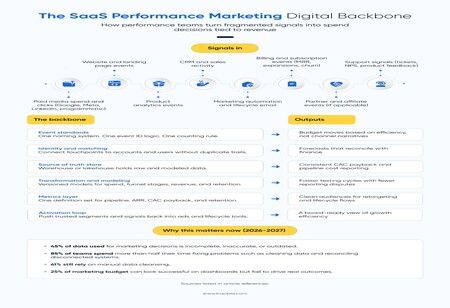
In practice, the digital backbone has six layers:
- Clean event capture across product, web, sales, and partner touchpoints
- Identity resolution so one buyer journey does not split into five records
- A central warehouse as the source of truth
- A metrics layer with consistent definitions for revenue, pipeline, CAC payback, and retention
- Activation pipes that push audiences and signals back into ad platforms and lifecycle tools
- Monitoring and controls for freshness, duplication, and schema drift
Most teams fail on standardization, real-time access where it matters, and controls that keep the system reliable as volume rises.
Cloud-native scale, real-time processing, and security controls are the baseline for growth-stage SaaS stacks. This is where platforms like Trackier come in, providing native conversion syncs and monitoring that significantly dial down the reconciliation time and help keep spend-to-revenue loops tight.
The Operating Model That Makes the Backbone Work
A modern data backbone only pays off when the operating model changes with it. Budgets need to rise to match tooling and channel sprawl.
Gartner’s 2025 CMO Spend Survey found marketing budgets flat at 7.7percent of company revenue. That puts pressure on proof.
Also Read: India–US Trade Deal: Big Gains for India?
This is where many teams stall. They can report pipeline and revenue, yet they cannot defend efficiency with finance-grade stats. 6 out of 10 B2B marketers track the pipeline, only 1 in 3 report new ARR, and rarely any of them track marketing cost per dollar of the pipeline. The system does exist, but the discipline is widely inconsistent.
CXOs should treat performance marketing as a closed loop with 3 rules of thumb:
- One metric dictionary for pipeline, ARR, CAC payback, and revenue attribution, signed off with sales and finance
- Data SLAs for freshness and completeness, plus ownership for every source and field
- A weekly spend-to-revenue cadence where budget changes are based on efficiency metrics
AI will accelerate reporting and triage, but it will not fix broken inputs. The use of AI or ML is quite low when compared to the total time businesses invest in optimizing and automating marketing efforts.
Estimates and expectations are high when it comes to the question of AI implementation rising in the coming couple of years, but that scale-up will only work when the underlying data is consistent.
Also Read: 1947 to 2026: Evolution of India-France Diplomatic Relationship
The Six Checks That Keep Marketing Honest
In a January 2026 benchmark cited by the latest Demand Gen Report survey set, 66percent of respondents said they use 11 or more marketing tools, and 85percent said they spend more than half their time fixing issues such as data cleaning and reconciling disconnected systems.
When we audit a system, we end with a six-part checklist. Miss one layer and reporting issues pile up quickly:
- Event discipline: one naming standard, one event ID logic, one counting rule
- Identity stitching: link actions across devices, channels, and systems into one profile
- Central store: warehouse or lakehouse as the source of truth, with clear owners
- Transformation: version-controlled models for spend, touchpoints, pipeline, and revenue
- Metrics layer: governed KPI definitions so CAC payback and pipeline cost match everywhere
- Activation loop: trusted segments and signals pushed back into execution tools
A simple, practical goal for the next quarter: make the numbers consistent, make them fast, then make them usable inside the workflows where spending decisions happen.