

Amitabh Kant Highlights India’s Path to Dominating Electric Vehicle Manufacturing
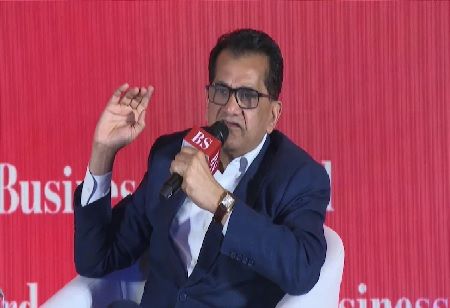 India's G20 Sherpa and former Niti Aayog CEO, Amitabh Kant, stated that domestic automakers such as Tata Motors and Mahindra & Mahindra will prevent Tesla from dominating the Indian market. He also advocated for a nationwide shift to electric vehicles (EVs).
During his address at the second edition of Manthan, Business Standard’s flagship thought summit, Kant stressed the importance of India becoming a global leader in EV manufacturing, particularly in the two-wheeler and three-wheeler segments, where the country has a strong export base.
“Tatas and Mahindras will not allow Tesla to succeed, their prices are very competitive”, Kant explained.
Elon Musk’s Tesla is currently scouting locations for a completely knocked-down (CKD) assembly unit, despite opposition from US President Donald Trump to its plans for EV manufacturing in India, sources said.
In recent days, Tesla has been in talks with Andhra Pradesh, which is offering pre-acquired land options in Nellore district, Sri City in Tirupati district, and close to the Kia cluster in Anantapur district, a source familiar with the discussions confirmed.
Kant urged the government to lead by example for EV transition. “Every Indian should move to an EV, and the government should not buy any fossil fuel cars. The government should become the first driver of EV adoption,” he said at the event.
Kant noted that private sector growth will fuel Prime Minister Narendra Modi’s Viksit Bharat vision.
“We need to scrap many more rules, regulations, and procedures, and make India a nation where free enterprise can grow and flourish. That, to my mind, is very important”, Kant said.
Citing the example of the United States, he said America controls 26 per cent of the global gross domestic product (GDP) and 44 per cent of market capitalisation, despite having just 4 per cent of the world’s population, due to the clout the country’s private sector commands.
“A huge number of regulations have been built up by every single regulator in India. Every department starts regulating. There's an excessive dose of regulation. All this does not need to just get out of the way, but be totally dismantled,” Kant noted.
For the next six months, reform and deregulation should be the key focus areas. The real action is now in the states, which must dismantle regulatory burdens in a big way and focus on reforms. “Deregulate, deregulate, deregulate. That is the key.”
He said India will normally grow at 6 per cent, but there is a need to accelerate this to about 8.5–9 per cent. To achieve this, states will be required to do the heavy lifting.
Highlighting the scale of India’s economic challenge, Kant pointed out that for India to grow from a $4 trillion to a $30 trillion economy, its GDP must expand nine times, and manufacturing increase by 16-fold. He stressed that this transformation requires mass participation, particularly from the 50 per cent of the population that is currently not actively contributing to the economy.
India’s path to becoming a $30 trillion economy demands relentless hard work, not an obsession with work-life balance.
“I strongly believe in hard work. Indians must work hard, whether it’s 80 hours or 90 hours a week. If your ambition is to move from a $4 trillion to a $30 trillion economy, you can’t do it through entertainment or by following the views of some film stars,” he weighed in.
He cited the examples of Japan, South Korea, and China, which achieved success through work ethic and hard work.
On the debate on work-life balance, he argued that there is enough time for personal well-being within a disciplined work schedule. “In the name of work-life balance, don’t make it fashionable for people to avoid hard work. We are sending the wrong message to the young generation of India—that India can become a great nation without working hard. No country has been able to do this,” Kant added.
On the role of artificial intelligence (AI) and emerging technologies, Kant dismissed fears of job losses, stating that, throughout history, technological advancements have always created new jobs.
“Every advent of technology has led to the creation of more jobs, but of a different kind. What India needs is to train its workforce for the future, ensuring they benefit from AI-driven job creation”, he added.