

EAM Jaishankar Talks Global Developments With UN Chief Guterres
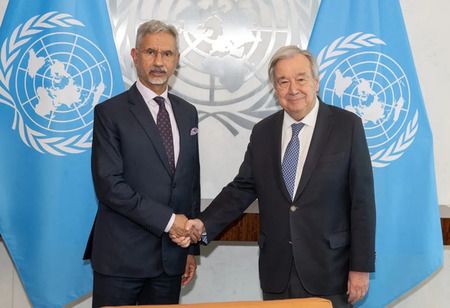
External Affairs Minister S. Jaishankar met with United Nations Secretary-General Antonio Guterres in New York, where they talked about important global issues, such as the tensions in West Asia, Ukraine, and Sudan, as India officially began its bid for a non-permanent position on the United Nations Security Council (UNSC) for the term 2028-2029.
The senior-level discussion occurred on the margins of India's UNSC campaign launch at the UN Headquarters, indicating New Delhi's diplomatic efforts to gain support from UN member states prior to next year's election.
The conversations centered on urgent global crises and the ongoing collaboration between India and the United Nations regarding various international matters.
Also Read: Tata Capital Forays into Gold Loans With Yogloans Acquisition
"Glad to meet @antonioguterres, Secretary General of the UN in New York today. Discussed global developments, including of West Asia, Ukraine and Sudan. Also recognised the strength of India-UN cooperation," Jaishankar said in a post on X.
Speaking to diplomats and delegates globally, he stated that India would represent the Global South on the Security Council and emphasized the nation's history of aiding developing countries, participating in UN peacekeeping missions, and striving to reinforce multilateral institutions.
"Never before has the world possessed such immense capabilities to advance human welfare at this scale. At the same time, we are witnessing levels of conflict, violence and instability that threaten even those who may be very far away.
Also Read: India-NZ FTA Will Deepen Economic Ties, Boost Trade: PM Modi
"To address this complexity, the United Nations must take the lead and the Security Council must show the way. Elections to its membership, consequently, assume great importance," he says.
India's SHANTI framework identifies six key priorities for its UNSC initiative. These involve amplifying the Global South's influence in global peace and security, fostering a reformed multilateral system that is democratic, representative, and efficient, developing a future-ready peacekeeping framework utilizing advanced technology, endorsing a human-centered perspective on artificial intelligence, advocating for a free, open, and rules-based maritime order aligned with international law, and enhancing worldwide initiatives to combat terrorism and financing of terror.
Also Read: IKEA Deepens Haryana Focus as Gurugram Project Advances
Jaishankar stated that India's stance would be driven by dialogue, collaboration, and endeavors to reconcile differences, while promoting reforms that represent modern global realities. He also emphasized India's dedication to promoting the Women, Peace and Security agenda and ensuring that peacekeeping operations stay centered on their fundamental goals.
India will compete in next year’s UN General Assembly election for the Asia-Pacific non-permanent seat on the Security Council for the term 2028-2029. If successful in the election, it will represent the nation's ninth term as an elected member of the 15-member Council.
"We are all aware that global governance has to reform in order to transform. For that to happen, multilateralism must be democratic, representative and effective," he said.
New Delhi is concurrently advancing its enduring request for a permanent position on a restructured UN Security Council while also aiming for election to a non-permanent seat to maintain its influence in conversations regarding global peace and security.