

Karnataka Exporters Gain as IMEC Emerges Hormuz Alternative
Owing to geopolitical tensions in the Middle East connectivity was hindered with Strait of Hormuz and Suez Canal as the choke points. Now with India-Middle East-Europe Economic Corridor (IMEC) gaining momentum as alternatives to the choke points, exporters from Karnataka and other states in India stand to gain in the global trade market.
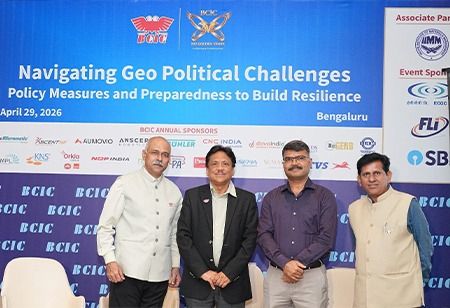
Dr. Kotraswamy M, IRS, Commissioner of Central Tax, Bengaluru North addresses a half-day seminar on ‘Navigating Geo-Political Challenges: Policy Measures and Preparedness to Build Resilience.’ The seminar was jointly organized by the Bangalore Chamber of Industry and Commerce (BCIC) in association with the Indian Institute of Materials Management (IIMM) in Bengaluru.
“With this development, several critical choke points especially fuel-related disruptions are expected to increase. IMEC is now gaining momentum as a more efficient and more reliable pathway, instead of depending on routes like the Suez Canal, the Strait of Hormuz, or even the Cape route which are costly in terms of freight and sailing time,” adds Dr. Kotraswamy.
In parallel, exporters are being provided targeted relief under the 56th GST framework. As exports are treated as zero-rated supplies under GST, the effective tax incidence on exports is zero percent, allowing businesses to claim refunds on input taxes paid. Refund mechanisms have also been significantly streamlined, with over 90 percent of eligible GST refund claims now being processed within 7 days, compared to earlier timelines of 15-30 days.
Also Read: India-Africa Relationship Enters New and Decisive Phase
Additionally, under recent GST Council recommendations, automatic refund processing and reduced documentation requirements have cut compliance costs by an estimated 20-25 percent for exporters, thereby improving liquidity and easing working capital pressures, highlighted Dr. Kotraswamy.
Highlighting Karnataka’s export performance Prince Mehra, Deputy Manager, EXIM Bank, noted that the state is the 4th largest exporter in India, contributing around 7 percent to the country’s merchandise exports and recording a steady growth of 7.8 percent CAGR from FY19 to FY25. In FY25, Karnataka’s exports stood at $ 30.5 billion, driven by telecom instruments (17.3 percent) and petroleum (14 percent), followed by electrical equipment (5 percent), RMG/apparel (4.7 percent), electronics (4.2 percent), coffee (4.1 percent) and pharmaceuticals (3.8 percent). He further added that Karnataka ranks 6th in NITI Aayog’s Export Preparedness Index 2024 and holds an untapped export potential of $ 24.4 billion.
Emphasising resilience, CA K. Ravi, Senior Vice President, BCIC and Chairman of the International Business Expert Committee says, “In today’s volatile global landscape, resilience is no longer optional as it is a strategic imperative. Geopolitical challenges are reshaping trade dynamics and compelling businesses to rethink risk, cost, and continuity. Mrs. Sivasankari Murugan, DGM & Regional Manager-Southern Region, ECGC spoke about ECGC Products & Services and India’s proactive interventions, policy measures such as the RELIEF Scheme, the Export Promotion Mission, reflecting a strong commitment to safeguarding industry competitiveness. She added that industry platforms such as this seminar play a crucial role in equipping stakeholders with the tools and collaborative mindset required to navigate uncertainty.
Also Read: Snabbit’s $56 Million Series D Fuels India Leadership Bid
A panel discussion on “Global Trade: Risk, Resilience, Reinvention” featured industry leaders including Somnath Chatterjee (ITC Ltd.), Roshi Panthri (State Bank of India), Bobin John (Expeditors International India Pvt. Ltd.) and K.V. Sudheendra (IIMM) and was moderated by R. Sampath Raghavan, EC Member and Senior Faculty, IIMM.
Also Read: Flipkart, Axis Bank and PayU Launch Biometric Card Payments
The seminar brought together policymakers, industry leaders, financial institutions and trade experts to deliberate on the evolving geopolitical landscape and its implications for India’s export-import ecosystem, underscoring the need for coordinated action between government and industry to build a resilient and future-ready trade framework.