

5 Powerhouse Leaders behind Bangalore’s Rise as India’s IT Hub
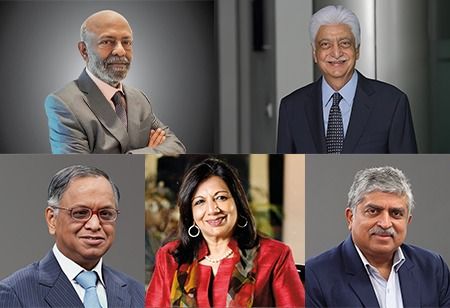 Bangalore has undergone a dramatic evolution over the last several decades: only a couple of decades ago it was an unassuming, green-hued city with many tree-lined streets inhabited by some of the most significant public sector undertakings and research institutions. Now it is the undeniable IT capital of India. The initial bedrock of science and technology in the area came through the establishment of organizations such as the Indian Space Research Organization and Hindustan Aeronautics Limited.
The economic liberalization of the 1990s, along with the ever-increasing number of experienced engineers who continued to join the workforce, combined with favorable government policy towards the establishment of a technology sector in India and the beginning of global outsourcing accelerated the transition of Bangalore to its current status as a significant technology and business hub in India.
The major transformations were a number of significant business leaders who built multiple successful organizations and then, in doing so, contributed to creating a significant ecosystem for building entrepreneurship, global collaboration, and technological excellence. Together, they all contributed to the rapid development of Bangalore to be known as the Silicon Valley of India.
Nagavara Ramarao Narayana Murthy
Narayana Murthy launched Infosys with only $250 in 1981 and continued to build Bangalore into a global technology center by being an innovator and visionary entrepreneur. After receiving many awards for services and contributions to India's economy throughout his career since 1981, Narayana Murthy and Infosys are now considered international giants and one of the most highly-respected IT service companies in India.
1993 will forever be significant, as it marked the day that Infosys went public. The IPO was significant because it showed that globally investors were beginning to gain confidence in Indian technology firms.
Today, Infosys is an international public corporation with a market capitalization of billions of dollars, which demonstrates that it has continued to grow and innovate its business while gaining the trust of the global investor community.
Under Narayana Murthy's leadership and vision, Infosys has not only grown significantly but now employs nearly 300,000 people in total and is currently one of India's largest private employers. The company's training facility located in Mysuru is one of the largest corporate training centers in the world and has trained hundreds of thousands of engineers while also establishing benchmarks for companies to follow when developing their workforce. These investments in developing talent have been critical to sustaining the availability of high-quality technology workers in and around Bangalore.
Azim Premji
Azim Premji was helping transform Bangalore into a global IT hub for technology through transforming Wipro. Premji purchased Wipro at age 21 in 1966 when the company created primarily vegetable oils. He recognized early that technology had great potential and repositioned Wipro to enter the technology sector by moving into that business during the late 1970s & 1980s, making Wipro one of the first Indian companies to enter the international software services market.
In 1980, Wipro went public and became a global IT Company; this was to promote a new corporate culture across India. Today, Wipro operates across more than 60 countries and employs more than 250,000 people worldwide.
With Wipro's headquarters in Bangalore, significant presence has contributed to Bangalore drawing many multinational corporations and reaffirming its place as a key hub for high--end software development and consulting services.
Azim Premji had more than just scale as a major influence; he emphasized quality and excellent processes that led to Wipro being one of the first Indian firms to adopt global business standards, such as SEI -CMM Level 5. By focusing on quality and developing trust from an international perspective, it helped to create confidence with worldwide companies that Indian technology companies can provide quality technology solutions.
Also Read: Venezuela Interim President Appoints New Oil Minister
Nandan Nilekani
Through his co-founding of Infosys (founded in 1981), Nandan Nilekani has played an important role in developing both Bangalore’s technology community and the digital infrastructure for the entire country of India. He was instrumental in taking Infosys, which he became CEO of in 2002 until 2007, from a small company to an international IT company. He also built many international offices and helped establish Bangalore as one of the world’s leading technology service delivery centers.
In spite of occupying many executive and managerial positions throughout his career, Nilekani’s most notable contribution to India and Bangalore is serving as the first chairman of the Unique Identification Authority of India, which established the Aadhaar program. The Aadhaar program was an essential first step in building India’s digital public infrastructure, which led to the creation of innovative solutions for many industries and sectors, such as FinTech and E-Government, and providing a more direct way of providing government benefits.
Also Read: 5 Notable Indian CHRO Appointments in February 2026
Kiran Mazumdar-Shaw
In the early days of her founding Biocon, Kiran Mazumdar-Shaw had originally planned to run it out of her garage and produce industrial enzymes. Subsequently, due to the success of her business and the evolution of the biotech industry over time, Biocon emerged as one of the leading biotech companies in the world, with operations in over 100 countries and the ability to develop biopharmaceuticals/therapeutics for patients worldwide through their manufacture of biosimilars and innovative biologics while at the same time helping to make critically important/medically necessary drugs more available and affordable through financial assistance programs operated within various factors on an international level as well as through its involvement in research projects to find new approaches to these problems.
As such, Kiran Mazumdar-Shaw has also played a critical role to help Bangalore establish itself as a biopharmaceutical hub and co-located with it as an information technology hub. In addition to that, the Biocon Park has been built on this foundation and has become the largest collaborative biotech campus in Asia and through this infrastructure has helped to enable the biotech industry to grow in Bangalore and created thousands of highly-skilled job opportunities for members of this community through both research and manufacturing capabilities.
Also Read: 5 Key Leadership Appointments across Global Firms in March 2026
Shiv Nadar
India's IT sector was established in part due to the leadership of Shiv Nadar. He established HCL (Hindustan Computers Limited) in 1976, which would become one of India's first firms to develop technology starting with hardware during the point when computing was still at infancy stage. This move, therefore, would go on to become the foundation on which India's development into a leader in Global IT within the world would be based.
Today HCL has grown over the years into a worldwide Information Technology services and consulting entity having a presence in over 50 countries and employing over 220,000 people. The growth of HCL along with other early IT firms in India positioned both India and Bangalore as locations building global trust to develop quality technology services and foster innovation. HCL developed a global reputation for the value of its technology services by creating a strong ecosystem of talent from which employees were acquired as well as the infrastructure that supported them. The growth of HCL has contributed to the overall growth of Bangalore as the place to go in the world for creativity and technology.