

India's Logistics Sector: Building for the Next Phase of Growth
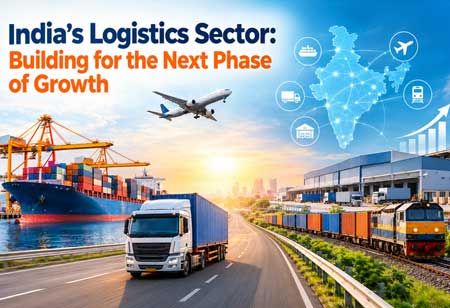 India’s logistics sector has undergone a significant transformation over the past few years, driven by infrastructure development, policy reforms and changing business needs. The market grew at an estimated annual rate of 11% between FY2019 and FY2024, with one estimate valuing it at around $240 billion in 2025. While these figures point to sustained expansion, the sector’s next phase will depend on how effectively it addresses persistent operational challenges and adapts to evolving supply chain requirements.
Policy initiatives have played an important role in shaping this growth. Introduced in 2022, the National Logistics Policy aims to improve efficiency, reduce logistics costs and position India among the top 25 countries on the World Bank’s Logistics Performance Index by 2030. India’s ranking improved from 44th in 2018 to 38th in 2023, reflecting progress, although further improvements will require sustained efforts across infrastructure, technology and service delivery.
Digital integration is another important part of this transition. The Unified Logistics Interface Platform seeks to connect transport-related digital services through a common interface, while PM Gati Shakti promotes coordinated infrastructure planning across 16 ministries.
Demand-side changes have been equally influential. The growth of e-commerce has raised expectations around delivery speed, visibility and reliability, placing greater demands on logistics providers. Several initiatives have supported the expansion of organised logistics providers, although the degree of consolidation varies across market segments.
Despite these developments, measuring the sector’s efficiency remains a challenge. Estimates of India’s logistics costs differ considerably. NCAER placed the figure at 7.8% to 8.9% of GDP for FY2021-22, while other estimates have put it at 13% to 14%, with some projections suggesting 10% to 10.7% for FY2026. These differences may reflect variations in methodology, the activities included in the calculations and the periods covered. Without a consistently applied measurement framework, comparisons can be difficult, making it harder to assess progress accurately.
India’s logistics sector has established a stronger foundation through policy reform, infrastructure investment and rising demand from e-commerce and manufacturing. The next stage will be less about growth alone and more about the quality and efficiency of that growth..
Read more about the Indian logistics sector and some of the industry’s exciting players in the current edition of CEOInsights India magazine.
Let us know your thoughts.