

How US–China Tariffs Are Disrupting Textile Trade

Discover the impact of US–China tariffs on textile trade, supply chain disruption, and the shift toward alternative sourcing markets.
In a sharp escalation of trade conflicts, the United States and China entered a new era of tariff disputes. The impact of the tariff war on textile developed into a critical concern as China implemented a staggering 125 percent tariff on American goods, while the U.S. retaliated with a hefty 145 percent tax on Chinese imports.
Additionally, a new universal 10 percent reciprocal tariff has been introduced on products from all other trading nations. These impactful adjustments are dramatically altering the global economic landscape, especially affecting the Textile & Apparel (T&A) sector, which relies heavily on a balanced international supply chain and competitive pricing.
Sampath Raghavan, Member, Southern Region Apparel Council, EC Member and Senior Faculty, Indian Institute of Materials Management (IIMM) Bangalore says, “The Textiles and Apparel sector has seen the maximum volatility in terms of USA-China trade tariffs. But for a temporary 90-day reprieve enjoyed by China, the tariff imposed by the U.S on Chinese Textiles and Apparel has been very high. It surged dramatically in 2025, reaching an effective rate of around 135 - 140 percent under section 301 actions. This triggered a significant decline in Chinese imports in the U.S. This also accelerated the ‘China-plus-one’ strategy adopted by the US. Major gainers from this strategy are Vietnam, Bangladesh and India. Below statistics show a marked improvement of exports from these countries into the U.S at the cost of Chinese exports.”
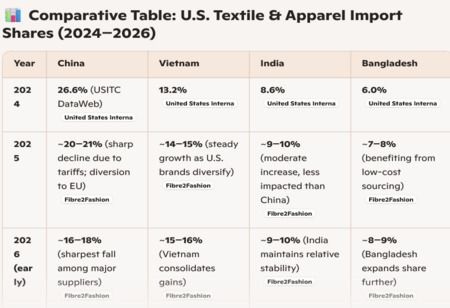
“Chinese exports to the US have seen a marked decline in the year 2025 with brands shifting their sourcing to Vietnam, Bangladesh & India thus diluting the reliance on Chinese imports. China, in response, launched investigations via MOFCOM focusing on supply chain disruption and green product trade barriers. As a fall out of this, EU imports from China rose 20 percent in early 2025 reflecting diversion from the US market. To offset decline in low end textiles and apparel China began to focus on High-tech textiles and automation. This partially offset losses in the lower end manufacturing by achieving economies of scale in this segment. With section 301 provisions still in place, the outlook for 2026 still looks to be volatile. Consequently China has strategized to shift manufacturing to South East Asia and African continent. This also augurs well for India in capitalizing on the higher tariff from China and building up scale and making inroads into the U.S. market.”
Ajay Ajmera, Founder & CEO, Ajmera Fashion Limited says, “India exports nearly $50 billion worth of goods to the Gulf region, and textiles are a major component of this trade. If shipping disruptions continue around the Strait of Hormuz, naturally some competing nations like China and Turkey may attempt to capture a portion of India’s market share. China has large-scale manufacturing capacity and strong logistics networks, while Turkey already has a presence in cotton fabrics and ready-made garments in Middle Eastern markets.”
“However, we must understand that India’s relationship with Gulf countries such as the UAE and Saudi Arabia is not just commercial, it is strategic and long-term. Agreements like the India–UAE CEPA, strong diplomatic engagement, and deep business networks provide India a significant advantage over competitors.”
“At the same time, India and its Middle East partners are actively working to ensure supply chain continuity. Alternative logistics routes through the Red Sea–Suez corridor, diversification of shipping lines, and new initiatives like the India–Middle East–Europe Economic Corridor (IMEC) are part of long-term solutions to reduce dependence on a single chokepoint.”
“So while competitors may try to step in temporarily, India’s geopolitical partnerships, supply reliability, and strong textile ecosystem will ensure that we recover and maintain our market leadership in the Gulf region.”
Abhishek Sharma, CEO & Co-Founder, Fashinza, a supply chain and product development platform for fashion industry says, “The US–China trade tariffs have definitely pushed brands to rethink how dependent they want to be on a single sourcing market. China is still incredibly important because of its scale and efficiency, but more and more brands are now actively building a “China+1” strategy to reduce risk.”
He highlights the growing attention being garnered by countries like India, Vietnam, and Bangladesh. “But just having capacity isn’t enough anymore. Brands care equally about speed, consistency, and visibility across the supply chain,” he further adds.
“At Fashinza, we’re seeing this shift play out in real time. There’s a clear increase in demand from global brands looking to diversify sourcing without compromising on execution. Our recent acquisition of Qckin is also aligned with this, building stronger; more integrated manufacturing capabilities so we can offer better control and reliability.”
“In reality, this isn’t about moving away from China completely. It’s about building a more balanced, multi-country sourcing setup that can handle uncertainty better.”
New Tariff Landscape
China’s imposition of a steep 125 percent tariff on U.S. goods acts both as a punitive measure and a strategic effort to rebalance trade, increasing costs for American textile and apparel producers dependent on Chinese markets for production and consumption.
In response, the United States has enforced a 145 percent tariff on Chinese imports, making affordable textiles, fabrics, and apparel from China significantly more expensive for American consumers. This move aims to strengthen domestic industries while pushing importers to rethink their sourcing strategies, underscoring the far-reaching impact of the tariff war on manufacturing.
Additionally, 10 percent tariff on imports from other countries has been introduced to prevent companies from bypassing these restrictions by shifting production to lower-tariff regions. As a result, alternative sourcing hubs such as Bangladesh, Vietnam, and Turkey are gaining prominence, further transforming global supply chains. Collectively, these measures are exerting pressure on both economies, disrupting demand and supply patterns, and creating complex challenges for the textile and apparel industry, which relies heavily on interconnected global production networks.
Effects on the Global Textile and Apparel Manufacturing Industry
Disruption and Reconfiguration in Supply Chains
The transformation of sourcing strategies in the textile and apparel sector is becoming increasingly evident as companies move away from their long-standing dependence on China for cost-effective production. With the United States imposing tariffs on Chinese goods, manufacturers are being pushed to explore alternative destinations for production. However, these emerging sourcing hubs often fall short in terms of efficiency, quality consistency, and large-scale production capacity that China has developed over decades.
Moreover, the introduction of a universal 10percent tariff on imports from other countries adds another layer of complexity, making it difficult for companies to fully disengage from China. This situation has created what can be described as a “tariff triangle,” where manufacturers must carefully evaluate the total cost implications of shifting production. Beyond tariffs, factors such as transportation costs, labor quality, infrastructure, and supplier reliability play a crucial role in decision-making, forcing companies to adopt a more strategic and nuanced approach to global sourcing.
Also Read: Celebrities Poured into Wimbledon 2025
Financial Pressures and Pricing Dilemmas
Escalating production costs are becoming a major concern for textile and apparel manufacturers as heightened tariffs continue to drive up expenses across the value chain. The steep 145 percent tariff on Chinese inputs significantly increases the cost of raw materials and intermediate goods, placing additional financial strain on producers who have long relied on China for affordable sourcing. Even when companies attempt to shift production to alternative markets, the added burden of a universal 10 percent tariff further compresses already thin profit margins in this highly competitive industry.
Besides, passing these increased costs on to consumers poses a significant challenge, particularly in price-sensitive markets where even slight increases in retail prices can impact purchasing decisions. As a result, brands are forced to strike a delicate balance between maintaining profitability and preserving customer demand, carefully managing pricing strategies to avoid losing market share while navigating the ongoing pressures of tariff-induced cost inflation.
Market Dynamics
Emerging production hubs across Southeast Asia, including Vietnam, Bangladesh, and India, are increasingly positioned to capture market share once dominated by China, as companies diversify their sourcing strategies in response to tariff pressures. However, to truly compete at scale, these countries must invest significantly in improving quality control, strengthening infrastructure, and expanding production capacity to match China’s well-established manufacturing ecosystem. In this evolving landscape, many manufacturers are adopting “dual sourcing” strategies, enabling them to spread risk and maintain flexibility in the face of ongoing trade uncertainties.
However, the rise in tariffs has accelerated the need for strategic alliances within the textile and apparel industry. Companies are forming partnerships to pool resources, drive supply chain innovation, and secure favorable terms through long-term agreements. Collaborations with technology providers are also gaining traction, particularly in areas such as logistics optimization, real-time tracking, and demand forecasting, helping businesses build greater resilience and adaptability against future tariff disruptions.
Also Read: How This Techie Turned Visa Struggles into Startup Success
Innovation and Adaptation in the Industry
The growing economic pressure from tariffs is pushing textile and apparel manufacturers to place greater emphasis on automation and sustainability as key drivers of long-term competitiveness. To offset rising costs, companies are increasingly adopting advanced technologies such as robotics, digital manufacturing processes, and data-driven operations to enhance efficiency and reduce waste. Sustainable practices ranging from eco-friendly materials to energy-efficient production are becoming integral, not only for cost management but also for meeting evolving regulatory standards and consumer expectations.
Alongside this shift, businesses are also adapting to changing demand patterns caused by disruptions in global trade flows. Fluctuations in export markets and regulatory environments are compelling firms to become more agile and responsive to consumer preferences. As a result, flexible manufacturing approaches such as on-demand production and modular assembly lines are gaining traction, enabling companies to quickly adjust output, minimize inventory risks, and better navigate the uncertainties of an increasingly volatile global market.
Also Read: 5 Key Leadership Appointments across Global Firms in March 2026
Strategic Approaches for the Future
Risk management and contingency planning have become critical priorities for textile and apparel businesses navigating an increasingly volatile tariff environment. Companies are recognizing the need to establish comprehensive risk frameworks and conduct regular scenario analyses to anticipate potential policy shifts and their financial implications.
Building contingency reserves, diversifying supplier bases, and investing in robust market research are essential strategies to mitigate the impact of sudden regulatory changes. The engagement and collaboration across the industry are gaining momentum, with trade associations and industry bodies actively working with policymakers to advocate for more stable and predictable trade agreements.
By presenting unified data and real-world case studies, stakeholders aim to influence future negotiations and ease the burden of steep tariffs imposed during ongoing trade tensions. Complementing these efforts is a strong push toward digital innovation, as companies adopt advanced platforms to streamline inventory management, optimize order processing, and improve supply chain transparency. These digital solutions not only enhance operational efficiency but also equip manufacturers with the agility needed to respond effectively to shifting tariff dynamics, helping them sustain a competitive edge in a rapidly evolving global market.
In conclusion, the recent surge in tariffs including China's 125 percent tax on U.S. goods, the U.S.'s 145 percent tax on Chinese imports, and a uniform 10 percent tax on products from other nations is causing reverberations throughout the global Textile & Apparel industry. Despite aiming to safeguard domestic interests and recalibrate trade dynamics, these measures introduce considerable uncertainty into international supply chains. The industry's response is likely to involve diversifying sourcing locations, investing in automation, forging strategic partnerships, and increasingly leveraging digital technologies.