

Healthcare Industry In India: What Lies Ahead
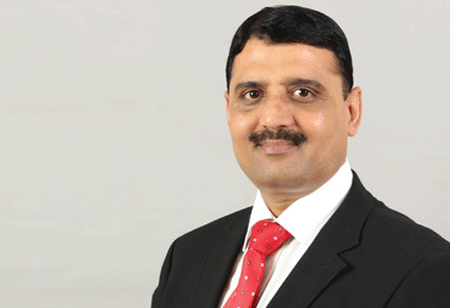
Hemraj Singh Parmar, CEO, BR Life, 0
Healthcare industry in India is currently passing through a very critical phase in its growth journey. In the economy size of approximately $2.9 trillion and healthcare market size of about $160-180 billion, India spends close to 4.7 percent of its GDP on healthcare of which close to 1.15 percent comes from the government coffers. The rest comes from the private industry. More than 65 percent of the healthcare expenditure still comes for Out of Pocket (OOP), one of the highest in the world, despite decades of independence. The US spends close to 18 percent of GDP on healthcare, a figure likely to spiral to 25 percent over the next few years. India cannot be a $5 trillion economy without safer, more affordable and accessible healthcare delivery to its masses. Currently, the country has only about 22 percent of the population covered by insurance. In a country of 1.37 billion people, close to a billion still remain uncovered. This is a huge challenge, in as much as it is an opportunity for growth, both for the private industry and the government of India.
Ayushman Bharat is a step in the right direction to address this challenge of gargantuan proportions and will be the precursor to 'Universal Health Coverage and 'Value Based Care'. More than 50 million families will be covered under the scheme. Close to 67percent of the Indian population stays in rural areas. The healthcare delivery in the urban areas is twice as much as that in the rural areas. One of the major challenges for Ayushman Bharat will be bridge this divide. Healthcare delivery is still very skewed in the rural areas. Not many private players are willing to establish healthcare enterprises in the rural areas a critical requirement to meet the ends of Ayushman Bharat. Reasons are many and none the least is unviability of the investment.
Healthcare is a capital intensive industry. A hospital can take anything from three to four years to break even. Add to that two to four years more for planning and
construction activities. A cash break even and payback can take much longer, so that's a huge risk. Government doesn't have the funds to invest and the private healthcare players must there by pitch in to ensure, we meet the ends of safe, affordable and accessible healthcare delivery. This calls for incentives from the government to the private industry to mitigate inherent risks and make their investments viable. Moreover, we need to also find more innovative and asset light healthcare delivery models for rural and tribal areas, may be based on hub and spoke. Last mile delivery is the key to success of Ayushman Bharat.
Putting of price caps on stents implants and several drugs has shaved off substantial margins off the healthcare providers, there-by putting immense downward pressure on their profitability. The industry outlook is therefore, currently moderately negative. Lot of smaller unviable healthcare businesses are currently on sale. This is not a good sign for long term growth of the industry. We need to incentivize healthcare providers to invest and make sure they can generate modest margins. We need to give fillipto Make in India and reduce dependence on expensive imports of medical devices, drugs and implants.
Some of the prevailing healthcare costs are un sustainable and the providers there fore need to have a ‘de novo'look at them and realign costs as per the prevailing industry dynamics.
Government needs to ensure upward revision of the procedure costs of 1350 odd procedures under Ayushman Bharat. These are unsustainable and not attractive enough to ensure fresh investments. Our public healthcare system needs a major overhaul, currently teetering on the brink of collapse. We also need a new medical education paradigm. Preventive medicine, hitherto ignored too needs major investment. Accent now is on ‘Smart Hospitals' which improve patient safety and outcomes, while helping bring down delivery costs. Latest technologies such as AI, IoMT, big data, 3D/4D printing, blockchain robotics, wearables, precision medicine, virtual reality, connected health are going to disrupt the industry. Care will thus, shift from the hospitals to your homes in future.
We must therefore learn to live in the VUCA world to stay viable and relevant!
We need to also find more innovative and asset light healthcare delivery models for rural and tribal areas, may be based on hub and spoke
Putting of price caps on stents implants and several drugs has shaved off substantial margins off the healthcare providers, there-by putting immense downward pressure on their profitability. The industry outlook is therefore, currently moderately negative. Lot of smaller unviable healthcare businesses are currently on sale. This is not a good sign for long term growth of the industry. We need to incentivize healthcare providers to invest and make sure they can generate modest margins. We need to give fillipto Make in India and reduce dependence on expensive imports of medical devices, drugs and implants.
Some of the prevailing healthcare costs are un sustainable and the providers there fore need to have a ‘de novo'look at them and realign costs as per the prevailing industry dynamics.
Government needs to ensure upward revision of the procedure costs of 1350 odd procedures under Ayushman Bharat. These are unsustainable and not attractive enough to ensure fresh investments. Our public healthcare system needs a major overhaul, currently teetering on the brink of collapse. We also need a new medical education paradigm. Preventive medicine, hitherto ignored too needs major investment. Accent now is on ‘Smart Hospitals' which improve patient safety and outcomes, while helping bring down delivery costs. Latest technologies such as AI, IoMT, big data, 3D/4D printing, blockchain robotics, wearables, precision medicine, virtual reality, connected health are going to disrupt the industry. Care will thus, shift from the hospitals to your homes in future.
We must therefore learn to live in the VUCA world to stay viable and relevant!