

The Arts, The Economy & The Fourth Industrial Revolution
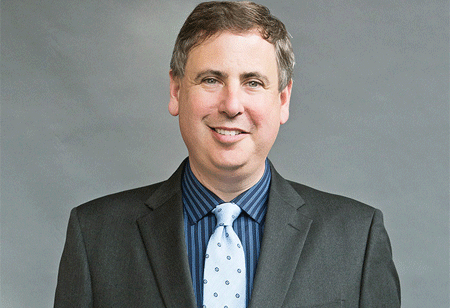
Jeffrey Sharkey, Principal, Royal Conservatoire of Scotland, 0
If experts are to be believed we sit on the cusp of a new industrial revolution. This time it’s a cognitive revolution; one in which robots and Artificial Intelligence will eventually undertake all but a few functions and tasks, the ones that require the very human qualities of emotional intelligence and empathy. While this may be a scary prospect for some, I would boldly suggest this is a time of opportunity for artists, for creative learning and for institutions like my own.
Here in the UK the creative industries are the fastest growing part of the economy, contributing £91.8 billion gross value added(GVA)in 2016, which was bigger than the automotive, life sciences, aerospace, oil and gas sectors combined. In India, too, the current contribution as well as future growth trajectories of the cultural sector and the creative industries more widely offers huge potential for employment as well as socio economic impact of considerable scale.
Many of the skills required to enable this sector to thrive sit at the very heart of a good arts education which, as well as disciplinary excellence, helps individuals build their entrepreneurial skills, the important skills of empathy, flexible and agile thinking as well as the ability to collaborate effectively. In addition and on top of the economic arguments for arts education its role in contexualsing change becomes ever more important. As India adapts to its new relationship with the global economy, and as with other societies experiencing rapid growth and change there are risks of losing traditions and a shared sense of values.
In this fastchanging environment I challenge our students to think about what they must do to have impact and thrive? The answer I believe, is for them to work hard at their own craft, be open to sharing and learning from other disciplines, be aware but not afraid of the world as it is, be optimistic about what it could be.
As Scotland’s centre of learning and teaching in the performing arts, we have a distinct national and international role and a distinct opportunity to effect change. We’re distinctive too in being multi art form (teaching classical and traditional music alongside drama, modern ballet, production and film) with a groundbreaking curriculum which, as well as enshrining disciplinary excellence also encourages cross disciplinary learning, collaboration and the creation of new art and new ideas in the spaces in between.
All art forms rely on connections between moments movement in time. We are not a static object like a
painting (though even those too can have a movement of their own). A single word, a single gesture a single note, a particular lighting moment in and of itself does not make our art come to life it is the joining of the notes the lines, the gestures the scenes that creates the flow and conversation on needed to make our art.
As artists we need to think about how we can make small grammatical moments like words, like a piece of cloth like a musical note into longer structures like a line or phrase, into more complete shapes. Artists, after all, are all architects in some way of their own future and of our shared future.
In that shared future and especially in these challenging times of change embracing the strength and importance of the arts will be essential. Those of use working in the arts and arts education know that. But many schools, authorities governments the world over have forgotten what the Western Eastern, and African cultures knew thousands of years ago that artistic education is not simply a luxury, but an essential for a healthy society.
But breadth of audiences and artists and creative entrepreneurs cannot be sustained or indeed established in the first place if young people are struggling to find affordable pathways to meaningful progress in the arts. Creating and sustaining routes of access is vitally important and all young people should have arts as an integral element of their education just like sport and physical education.
The tensions of accessibility and affordability come as across the world we sit at the edge of the ‘fourth industrial revolution’. If this revolution is a cognitive one, where automation will do more things that humans used to do, then we need to harness our creativity, our empathy and our understanding of multicultural societies more than ever. It is sustained learning and teaching in performing arts that will help give our children the adaptable skills they will need to not only survive in the future but to shape it.
‘Societus’in Latin means comradeship companionship, friendly association and bond between peoples. Can you imagine that being achievable only with finance, engineers, and computers?
Across the globe constrained finances and competing priorities always risk keeping focus away from what’s critical in the longer term. We can point this out until we are blue in the face, but I also think we(as arts organisations and global arts leaders) need to be part of the solution. We need to share best practices as vigorously as we share our advocacy. If every conservatoire, specialist school, community arts organisation gave some of thought and attention to achieve access, diversification and progression in the arts and to help us nurture an outward looking, creative and entrepreurial generation, then we could do some amazing things together.
IT is sustained learning and teaching in performing arts that will help give our children the adaptable skills they will need to not only survive in the future but to shape IT
As artists we need to think about how we can make small grammatical moments like words, like a piece of cloth like a musical note into longer structures like a line or phrase, into more complete shapes. Artists, after all, are all architects in some way of their own future and of our shared future.
In that shared future and especially in these challenging times of change embracing the strength and importance of the arts will be essential. Those of use working in the arts and arts education know that. But many schools, authorities governments the world over have forgotten what the Western Eastern, and African cultures knew thousands of years ago that artistic education is not simply a luxury, but an essential for a healthy society.
But breadth of audiences and artists and creative entrepreneurs cannot be sustained or indeed established in the first place if young people are struggling to find affordable pathways to meaningful progress in the arts. Creating and sustaining routes of access is vitally important and all young people should have arts as an integral element of their education just like sport and physical education.
The tensions of accessibility and affordability come as across the world we sit at the edge of the ‘fourth industrial revolution’. If this revolution is a cognitive one, where automation will do more things that humans used to do, then we need to harness our creativity, our empathy and our understanding of multicultural societies more than ever. It is sustained learning and teaching in performing arts that will help give our children the adaptable skills they will need to not only survive in the future but to shape it.
‘Societus’in Latin means comradeship companionship, friendly association and bond between peoples. Can you imagine that being achievable only with finance, engineers, and computers?
Across the globe constrained finances and competing priorities always risk keeping focus away from what’s critical in the longer term. We can point this out until we are blue in the face, but I also think we(as arts organisations and global arts leaders) need to be part of the solution. We need to share best practices as vigorously as we share our advocacy. If every conservatoire, specialist school, community arts organisation gave some of thought and attention to achieve access, diversification and progression in the arts and to help us nurture an outward looking, creative and entrepreurial generation, then we could do some amazing things together.