


Dinesh Lodha: Powering a Bold Turnaround and a New Era of Hyper Growth

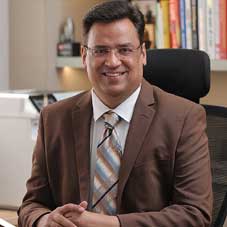
Dinesh Lodha
Managing Director & Group CEO
As healthcare systems become increasingly complex, leadership requires more than functional expertise; it calls for the ability to connect supplychains, distri -bution networks, commercial strategy, and customer needs into a cohesive business model.
Leaders who have worked across healthcare, medical technology, and consumer businesses bring valuable perspectives to this evolving landscape. Their experience enables them to navigate different stages of organisational growth while balancing profitability with operational reliability.
Dinesh Lodha, Managing Director & Group CEO of Medikabazaar, brings this cross-functional perspective to healthcare leadership. His professional journey began in finance, where he developed a strong understanding of cash flow, return on capital, and financial discipline.
At GE Healthcare, his responsibilities expanded across finance, supply chain, Six Sigma, general management, and sales leadership. This progression helped him develop an end-to-end understanding of business operations, while reinforcing the importance of reliability and trust in relationships with hospitals, doctors, distributors, and manufacturers.
His subsequent leadership roles broadened his experience across diverse business environments. At Healthium, he gained exposure to scaling a MedTech business and creating enterprise value within a private equity environment.
At Rupa & Company, he led a large listed consumer-facing organisation, navigating the interconnected demands of brand building, distribution, inventory management, working capital, and profitability. His tenure at TI Medical further strengthened his engagement with healthcare and medical technology.
These experiences shaped his belief that leadership must evolve with an organi -sation's needs. Highgrowth businesses, mature enterprises, and companies undergoing turnarounds each require distinct approaches. For Lodha, effective leadership begins with understanding the organisation's stage of development, establishing a clear purpose, building the right team, and creating accountability.
Equally important is the ability to execute with speed and discipline. At Medikabazaar, this breadth of experience provides a valuable foundation for navigating the operational and strategic demands of the healthcare supply chain while keeping business performance and stakeholder trust firmly in focus.
How has your leadership approach evolved as you have progressed from managing individual business functions to leading entire organisations, shaping strategy, culture and overall performance?
The biggest shift has been moving from managing individual functions to understanding organisational inter -dependencies. Every major decision affects multiple areas, from cash flow and customer relationships to technology, talent and culture. I evaluate decisions through three lenses: customer value, financial sustainability and execution at scale.
As a CEO, I must also build strong leadership teams rather than centralise every decision. My responsibility is to establish clarity, alignment and accountability while balancing strategy, performance, culture and governance to build an organisation that succeeds through strong systems and collective ownership.
What lessons from your leadership experiences at Rupa & Company and TI Medical have helped you navigate the complexities of healthcare distribution and MedTech at Medikabazaar?
Rupa taught me that revenue alone does not define business
success; margins, inventory efficiency, distribution productivity and cash generation matter equally. At TI Medical, I learned to build a business from the ground up and scale it through strong processes, quality and execution. These experiences reinforced the importance of identifying genuine customer needs and delivering consistent value.
At Medikabazaar, I bring together consumer business discipline and healthcare expertise to build a technology-enabled distribution platform. I also focus on simplifying complexity, prioritising the right customers and opportunities, and deploying capital where we can create sustainable value.
When you joined Medikabazaar in 2024, what were your immediate transformation priorities, and how did you balance business growth with profitability, accountability and stakeholder confidence?
I recognised that Medikabazaar had a strong foundation in healthcare relationships, technology and medical procurement, but needed a more disciplined and scalable operating model. We prioritised leadership ownership, empower - ment with account- ability, profit ability, cash flow and stronger governance.
Growth had to be supported by sound unit economics, better margins and working-capital discipline. Equally, protecting confidence among hospitals, manufacturers and other partners was essential.
My approach was to make the organisation clearer about priorities, faster in execution and more disciplined in resource allocation. A successful turnaround must create a fundamentally stronger business, not merely reduce costs.
How do you balance immediate financial priorities with long-term investments in technology, talent, exports and new business opportunities?
I believe businesses must strengthen present performance while building future growth engines. Our immediate focus remains profitable growth, margins, working capital, cash generation and customer service.
At the same time, we are investing in digital platforms, AI, analytics and supply-chain intelligence to prepare for the future of healthcare procurement. We are also developing domain expertise across pharma, specialty healthcare exports and institutional solutions.
Before entering adjacent markets, we assess our strategic advantage and the potential for sustainable economics. Long-term ambition cannot justify weak current performance, just as short-term targets should not prevent essential investments.
How are you fostering a culture of empowerment and ownership while ensuring that teams remain aligned with business goals, governance and performance expectations?
I believe empowerment and accountability must go together. Every team member, particularly in sales should understand their responsibilities, decision making authority and performance expectations. People closest to customers must have the confidence to act while remaining aligned with organisational objectives.
We are strengthening business reviews and KPIs to improve performance transparency, while maintaining financial governance, compliance and customer commitments as non-negotiable priorities. I encourage leaders to bring solutions rather than simply escalate problems. My objective is to build a culture where individuals take ownership of outcomes, make informed decisions and contribute independently to the organi- sation's success.
What criteria guide your decisions on new business opportunities, market expansion and investments in capabilities that can create long-term value for Medikabazaar?
I evaluate opportunities through five filters: customer relevance, strategic fit, market attractiveness, financial sustain ability and our right to win. We assess whether an opportunity solves a meaningful problem, leverages our existing capabilities and offers a credible path to margins, cash generation and returns on capital.
At Medikabazaar, I bring together consumer business discipline and healthcare expertise to build a technology-enabled distribution platform. I also focus on simplifying complexity, prioritising the right customers and opportunities, and deploying capital where we can create sustainable value.
My objective is to build a culture where individuals take ownership of out comes, make informed decisions and contribute independently to the organisation's success
When you joined Medikabazaar in 2024, what were your immediate transformation priorities, and how did you balance business growth with profitability, accountability and stakeholder confidence?
I recognised that Medikabazaar had a strong foundation in healthcare relationships, technology and medical procurement, but needed a more disciplined and scalable operating model. We prioritised leadership ownership, empower - ment with account- ability, profit ability, cash flow and stronger governance.
Growth had to be supported by sound unit economics, better margins and working-capital discipline. Equally, protecting confidence among hospitals, manufacturers and other partners was essential.
My approach was to make the organisation clearer about priorities, faster in execution and more disciplined in resource allocation. A successful turnaround must create a fundamentally stronger business, not merely reduce costs.
How do you balance immediate financial priorities with long-term investments in technology, talent, exports and new business opportunities?
I believe businesses must strengthen present performance while building future growth engines. Our immediate focus remains profitable growth, margins, working capital, cash generation and customer service.
At the same time, we are investing in digital platforms, AI, analytics and supply-chain intelligence to prepare for the future of healthcare procurement. We are also developing domain expertise across pharma, specialty healthcare exports and institutional solutions.
Before entering adjacent markets, we assess our strategic advantage and the potential for sustainable economics. Long-term ambition cannot justify weak current performance, just as short-term targets should not prevent essential investments.
How are you fostering a culture of empowerment and ownership while ensuring that teams remain aligned with business goals, governance and performance expectations?
I believe empowerment and accountability must go together. Every team member, particularly in sales should understand their responsibilities, decision making authority and performance expectations. People closest to customers must have the confidence to act while remaining aligned with organisational objectives.
We are strengthening business reviews and KPIs to improve performance transparency, while maintaining financial governance, compliance and customer commitments as non-negotiable priorities. I encourage leaders to bring solutions rather than simply escalate problems. My objective is to build a culture where individuals take ownership of outcomes, make informed decisions and contribute independently to the organi- sation's success.
What criteria guide your decisions on new business opportunities, market expansion and investments in capabilities that can create long-term value for Medikabazaar?
I evaluate opportunities through five filters: customer relevance, strategic fit, market attractiveness, financial sustain ability and our right to win. We assess whether an opportunity solves a meaningful problem, leverages our existing capabilities and offers a credible path to margins, cash generation and returns on capital.
This framework guides our expansion into institutional healthcare, digital procurement, pharma, specialty segments, exports, OEM partnerships and private labels.
An attractive market does not auto matically make it the right business for us. Capital allocation requires discipline, and I believe management must be as confident in rejecting unsuitable opportunities as in pursuing promising ones.
Which emerging trends will reshape healthcare procurement and supply chains over the next five years, and how should businesses prepare for these changes?
I see six major forces shaping the sector: digital procurement, AI-driven predictive intelligence, supplychain visibility, hospital consolidation domestic manufacturing and stronger regulatory traceability.
Digital platforms will improve transparency, while AI can optimise forecasting, inventory and procurement decisions.
Greater visibility and resilient sourcing will help ensure product availability, particularly as hospital networks become more institutionalised.
India's manufacturing capabilities will also influence procurement patterns. To prepare, businesses must invest in technology, domain expertise and adaptable operating models.
I believe future leaders will distinguish themselves by combining digital intelli-gence with reliable execution on the ground and a strong understanding of customer needs.
How do you recognise when a business must protect its existing strengths and when it needs fundamental reinvention to remain competitive?
I look for three signals: changing customer expectations, deteriorating business economics and shifts in technology or competition.
When customer needs outpace our ability to respond, or growth begins masking weaker margins and cash generation, leaders must reassess the business model. Competitive advantages can also erode before performance visibly declines.
However, reinvention does not mean abandoning established strengths. At Medikabazaar our healthcare relationships, manufacturer ecosystem and procurement expertise remain valuable.
We must continuously evolve how we translate these strengths into value through technology, data, new categories and international markets. A CEO must protect enduring strengths while challenging outdated approaches.
What is your vision for Medikabazaar's next phase of growth, and what lasting impact do you hope to create through your leadership?
My vision is to build Medikabazaar into a stronger, profitable, technology-led and globally relevant healthcare supplychain platform. We will deepen institutional healthcare, expand digital commerce, develop pharma and specialty segments, strengthen manufacturer partnerships and accelerate exports.
AI analytics and supply-chain intelligence will be central to improving interactions between hospitals and manufacturers. Through Project Bharat and our export strategy, we aim to connect Indian MedTech innovation with international markets.
However, scale alone is not the goal. I want to build an institution that combines growth with governance ambition with accountability and commercial success with meaningful contributions to healthcare accessibility and efficiency.
Dinesh Lodha, Managing Director & Group CEO, Medikabazaar
Dinesh Lodha is the Managing Director & Group CEO of Medikabazaar, bringing extensive leadership experience across healthcare, MedTech and consumer businesses. His professional journey includes leadership roles at GE Healthcare, Healthium, Rupa & Company and TI Medical.
With expertise spanning finance, supply chain, sales, business transformation and general management, he focuses on building scalable, profitable organisations through strategic clarity, operational discipline, technology adoption and accountable leadership.