


Dr Radheshyam Naik : A Legacy Of Compassionate, Research-Driven Cancer Care
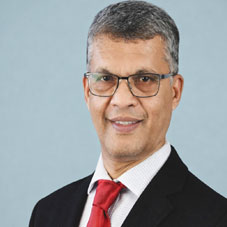
Dr Radheshyam Naik
Founder & Medical Director
Initial encounters with the significant effects of cancer motivated his desire to venture into this field not only as a clinician, but as a researcher and innovator to find ways of bettering available treat-ments, decreasing toxicity and enhancing prophylactic care.
This unique perspective, which considers cancer from a multifaceted, multi-vantage point, has led to Dr Radheshyam developing a patient-centred, research based oncology practice that provides holistic healing.
Dr Radheshyam started his academic career with an MD in Internal Medicine at KMC Mangalore, followed by a DM in Medical Oncology at Kidwai Memorial Institute of Oncology, Bengaluru.
He also developed his knowledge under superior fellowships and training in bone marrow transplantation, palliation, nutrition, and immunocompromised infections in the USA, UK, Israel, Europe, and Australia.
During a career spanning more than thirty years, he has worked in various top hospitals, including Manipal Hospital, St. Johns Medical College, HCG. He is currently the Founder, Medical Director and Head at Sammprada Hospital.
His career has been defined by clinical excellence, research leadership, teaching, and publications in the field of oncology and transplantation in India.
In this feature, Dr Radheshyam outlines his academic and professional journey while highlighting the leadership values that shaped his career.
What were the most transformative learning experiences you acquired from KMC?
My time at KMC was defined by outstanding mentors who instilled in me strong clinical, research, and analytical skills. I learned meticulous history taking and patient examination, research-driven thinking, and the importance of questioning and validating clinical decisions.
Faculty encouraged lateral and individua -lized approaches to treatment rather than routine protocols. Working in a high-volume government hospital
exposed me to diverse cases and resource-limited settings, teaching me cost-effective, patient-centered care. These formative experiences laid a solid foundation for my future work in oncology.
Could you also illustrate the accessibility of faculty to the students at KMC?
The faculties were highly accessible and approachable. They consistently encouraged open discussions and welcomed students for academic interaction.
Questioning and healthy debate were actively supported, and faculty members were receptive to differing viewpoints, even acknowledging corrections when appropriate.
This created a free, open, and intel -lectually stimulating learning environment that greatly enhanced the educational experience.
How have you made use of the alumni network when you were a student or after graduating?
I have not engaged with the alumni network in a very systematic manner, but I have remained in touch with a select group of former students and colleagues.
These connections, both in India and abroad, have been valuable for professional collaboration, referrals, and building links with other institutions, thereby supporting clinical practice and academic engagement.
What do you cherish most about your time at KMC?
What I cherish most about KMC is the vibrant, scientific, and intellectually stimulating environment. The strong camaraderie among students and faculty, interdisciplinary interactions, and a healthy balance between academics and extracurricular activities created a cohesive and enriching learning experience that left a lasting impression on my professional and personal growth.
What is your perspective on emerging healthcare technologies & their role in clinical decision-making and imple -mentation within your organization?
Emerging healthcare technologies, including artificial intelligence, are valuable tools for information gathering research, documentation and academic work, particularly in understanding new drugs and supporting presentations and publications.
However clinical decision-making and treatment remain strictly guided by established, evidence-based protocols such as NCCN guidelines. Technology supports knowledge enhancement and efficiency, while patient care and treatment decisions are
Leadership is not only about treatment out- comes, but also about creating long-term, meaningful impact in healthcare
Could you also illustrate the accessibility of faculty to the students at KMC?
The faculties were highly accessible and approachable. They consistently encouraged open discussions and welcomed students for academic interaction.
Questioning and healthy debate were actively supported, and faculty members were receptive to differing viewpoints, even acknowledging corrections when appropriate.
This created a free, open, and intel -lectually stimulating learning environment that greatly enhanced the educational experience.
How have you made use of the alumni network when you were a student or after graduating?
I have not engaged with the alumni network in a very systematic manner, but I have remained in touch with a select group of former students and colleagues.
These connections, both in India and abroad, have been valuable for professional collaboration, referrals, and building links with other institutions, thereby supporting clinical practice and academic engagement.
What do you cherish most about your time at KMC?
What I cherish most about KMC is the vibrant, scientific, and intellectually stimulating environment. The strong camaraderie among students and faculty, interdisciplinary interactions, and a healthy balance between academics and extracurricular activities created a cohesive and enriching learning experience that left a lasting impression on my professional and personal growth.
What is your perspective on emerging healthcare technologies & their role in clinical decision-making and imple -mentation within your organization?
Emerging healthcare technologies, including artificial intelligence, are valuable tools for information gathering research, documentation and academic work, particularly in understanding new drugs and supporting presentations and publications.
However clinical decision-making and treatment remain strictly guided by established, evidence-based protocols such as NCCN guidelines. Technology supports knowledge enhancement and efficiency, while patient care and treatment decisions are
standardized, carefully evaluated and tailored to individual patients based on proven clinical guidelines.
What are the guidelines or methodologies you follow to lead your team effectively?
My leadership approach is collaborative and democratic, centered on strong team structures, open communication, and continuous learning.
I lead primarily through clinical discussions during ward rounds where treatment decisions, reasoning, and alternatives are openly shared and debated. Team members at all levels are encouraged to voice opinions and challenge decisions, fostering critical thinking.
This consensus-driven, mentor- ship-focused approach has helped develop competent clinicians while ensuring high-quality, patient-centered care.
What future roadmap have you envisioned for yourself for the next five years?
My focus is on training and mentoring more medical oncologists, enabling them to lead clinical care while I concentrate on advanced research.
I plan to strengthen collaborative research with basic science institutions, translating findings into direct patient benefit.
A key priority will be preventive oncology, early detection, risk reduction, and awareness to improve cure rates by addressing cancers at earlier, more treatable stages and ultimately reducing cancer-related mortality.
What is your advice to future leaders?
Avoid shortcuts and the urge to move too fast. Focus on deeply mastering your specialty with patience, passion, and continuous learning. Leadership is not only about treatment outcomes, but also about creating long-term, meaningful impact in healthcare.
Dr Radheshyam Naik, Founder & Medical Director, Sammprada Hospital
A compassionate oncology leader and clinician researcher with over three decades of global experience, dedicated to advancing patient centered cancer care through innovation, research-driven practice, and holistic healing.
•Hobbies: I am a voracious reader across fiction nonfiction, and medicine; I enjoy listening to music, staying active with gym, yoga swimming, shuttle, and chess.
•Favourite Cuisines: I am a vegetarian and mostly enjoy South Indian vegetarian cuisine, but I also like North Indian and Mumbai-style foods.
•Favourite Books: I mostly enjoy philosophical works.
•Favourite Travel Destination: Bhutan, for its spiritual richness and simplicity, followed by Israel and Scotland, which I also deeply enjoyed.
What are the guidelines or methodologies you follow to lead your team effectively?
My leadership approach is collaborative and democratic, centered on strong team structures, open communication, and continuous learning.
I lead primarily through clinical discussions during ward rounds where treatment decisions, reasoning, and alternatives are openly shared and debated. Team members at all levels are encouraged to voice opinions and challenge decisions, fostering critical thinking.
This consensus-driven, mentor- ship-focused approach has helped develop competent clinicians while ensuring high-quality, patient-centered care.
What future roadmap have you envisioned for yourself for the next five years?
My focus is on training and mentoring more medical oncologists, enabling them to lead clinical care while I concentrate on advanced research.
I plan to strengthen collaborative research with basic science institutions, translating findings into direct patient benefit.
A key priority will be preventive oncology, early detection, risk reduction, and awareness to improve cure rates by addressing cancers at earlier, more treatable stages and ultimately reducing cancer-related mortality.
What is your advice to future leaders?
Avoid shortcuts and the urge to move too fast. Focus on deeply mastering your specialty with patience, passion, and continuous learning. Leadership is not only about treatment outcomes, but also about creating long-term, meaningful impact in healthcare.
Dr Radheshyam Naik, Founder & Medical Director, Sammprada Hospital
A compassionate oncology leader and clinician researcher with over three decades of global experience, dedicated to advancing patient centered cancer care through innovation, research-driven practice, and holistic healing.
•Hobbies: I am a voracious reader across fiction nonfiction, and medicine; I enjoy listening to music, staying active with gym, yoga swimming, shuttle, and chess.
•Favourite Cuisines: I am a vegetarian and mostly enjoy South Indian vegetarian cuisine, but I also like North Indian and Mumbai-style foods.
•Favourite Books: I mostly enjoy philosophical works.
•Favourite Travel Destination: Bhutan, for its spiritual richness and simplicity, followed by Israel and Scotland, which I also deeply enjoyed.