

Amit Kshatriya To Spearhead Nasa's Moon To Mars Program
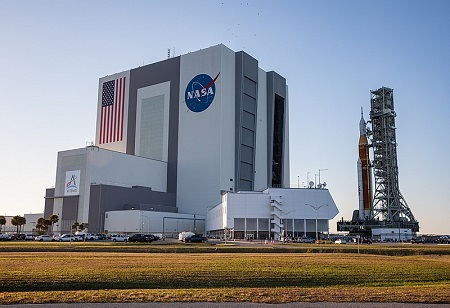 Indian-origin software and robotics engineer, Amit Kshatriya has been appointed as first head of NASA's new Moon to Mars Programme Office at the agency's headquarters in Washington.
The new office aims to carry out NASA's human exploration activities at the Moon and Mars for the benefit of humanity.
"The Moon to Mars Programme Office will help prepare NASA to carry out our bold missions to the Moon and land the first humans on Mars," said NASA Administrator Bill Nelson, in a statement.
"The golden age of exploration is happening right now, and this new office will help ensure that NASA successfully establishes a long-term lunar presence needed to prepare for humanity's next giant leap to the Red Planet."
As directed by the 2022 NASA Authorization Act, the Moon to Mars Programme Office focuses on hardware development, mission integration, and risk management functions for programmes critical to the agency's exploration approach that uses Artemis missions at the Moon to open a new era of scientific discovery and prepare for human missions to Mars.
This includes the Space Launch System rocket, Orion spacecraft, supporting ground systems, human landing systems, spacesuits, Gateway, and more related to deep space exploration.
The new office will also lead planning and analysis for long-lead developments to support human Mars missions.
The office resides within the Exploration Systems Development Mission Directorate (ESDMD), and Kshatriya, appointed as deputy associate administrator, will report to its Associate Administrator Jim Free.
Kshatriya previously served as acting deputy associate administrator for Common Exploration Systems Development, providing leadership and integration across several of the programmes that now fall within the new office.
In the new role, Kshatriya is responsible for programme planning and implementation for human missions to the Moon and Mars.
He will direct and lead the programmes to ensure Artemis and Mars planning, development, and operations are consistent with ESDMD requirements, and will serve as the single point of focus for risk management.
Kshatriya began his career in the space programme in 2003, working as a software engineer, robotics engineer, and spacecraft operator primarily focused on the robotic assembly of the International Space Station.
From 2014 to 2017, he served as a space station flight director, where he led global teams in the operations and execution of the space station during all phases of flight.
From 2017 to 2021, he became deputy, and then acting manager, of the ISS Vehicle Office, where he was responsible for sustaining engineering, logistics, and hardware programme management.
In 2021, he was assigned to NASA Headquarters in the Exploration Systems Development Mission Directorate as an assistant deputy associate administrator, where he was an integral part of the team that returned a spacecraft designed to carry humans to the Moon during the Artemis I mission.
Son of first-generation Indian immigrants to the US, Kshatriya holds a Bachelor of Science in Mathematics from the California Institute of Technology in Pasadena, California, and a Master of Arts in Mathematics from The University of Texas at Austin.
He has also been decorated with the NASA Outstanding Leadership Medal for actions as the lead flight director for the 50th expedition to the space station, as well as the Silver Snoopy -- an award that astronauts bestow for outstanding performance contributing to flight safety -- for his actions as lead robotics officer for the Commercial Orbital Transportation Services Dragon demonstration mission to the orbiting laboratory.