

BCIC Discusses 57th GST Council Reforms and Industry Concerns
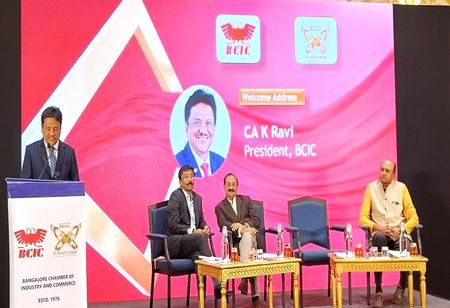
The decisions of the 57th GST Council were taken after extensive discussions and deliberations within the Government, including consultations with the States. All stakeholder concerns were given due consideration, and major process-related issues were addressed, Balasubramanian said while virtually addressing “The GST Reset – What the 57th Council Means for Business,” an interactive session organized by the Bangalore Chamber of Industry and Commerce (BCIC) in Bengaluru.
He added that the Government would now focus on implementing the recommendations and work closely with the States to ensure uniform implementation across the country.
CA K Ravi, President, BCIC, said, “Navigating tax reforms and bridging the gap between industry and government remains a key priority for BCIC. Through constructive dialogue, we advocate simplified compliance, policy clarity and seamless trade. As we celebrate our Golden Jubilee, we are strengthening our international presence, with plans to establish an office in Singapore, while advancing collaborations in AI research, industry engagement and social initiatives to create meaningful opportunities for members.”
N Venkataraman, Additional Solicitor General of India, who also addressed the gathering virtually, explained that restrictions on ITC reflected legislative policy choices and could be reconsidered when supported by convincing evidence. He observed that blocking credit was an exception rather than the general rule. Emphasising fairness in tax legislation, he also noted that retrospective amendments had, in certain instances, been introduced in favour of taxpayers to address difficulties involving transitional credits.
Also Read: Nexus Select Trust Names Siddharth Nawal as MD and CEO-Designate
Responding to a question on the possibility of removing e-way bills, Balasubramanian said an officers’ working group involving states had reviewed the mechanism and examined all aspects.
Also Read: Apna Raises Campus Tank Season 2 Funding Pool to $15 Million
He explained that e-way bill data supported logistics decision-making and served as a high-frequency input for economic forecasting and nowcasting undertaken by the Reserve Bank of India and statistical authorities.
Also Read: SML Mahindra Names Surender Kalra as Chief Financial Officer
However, he acknowledged concerns over indiscriminate stoppage of goods vehicles must be mitigated. The recommended reforms sought to address such practices by requiring specific intelligence and authorisation by an officer not below the rank of Joint Commissioner for interception, alongside restrictions on interception in transit states.