

BMRCL Targets 2027 Readiness for Bengaluru Airport Metro
Bengaluru Metro Rail Corporation Limited (BMRCL) shared a major update on the city’s long-awaited airport metro line, with operational readiness targeted by the end of 2027. The completion is expected to expand the city’s metro network to 175 kilometres, marking the largest single expansion to date.
Abhai Kumar Rai, Advisor (Civil), BMRCL, made the announcement while speaking at a panel discussion on ‘Sustainability in Action: Bengaluru’s Urban Challenge,’ organized jointly by the Bangalore Chamber of Industry and Commerce (BCIC) and The Energy and Resources Institute (TERI) in Bengaluru today.
Also Read: Karnataka Signs MoU with The Allegiance Group of Taiwan
Speaking as one of the panellists at the forum, Rai also outlined the upcoming expansion roadmap, noting ongoing work on Phase-3 (44 km), the preparation and sanction pipeline for Phase-3A (36 km) and feasibility studies covering over 200 km of future corridors. “We are moving ahead with Phase-3 spanning 44 kilometres and the DPRs for Phase-3A covering an additional 36 kilometres are already prepared and under consideration for sanction. Beyond that, we are studying over 200 kilometres of new corridors to support Bengaluru’s long-term mobility needs,” adds Rai.
Beyond network expansion, he drew attention to metro efficiency technologies such as regenerative braking, which is enabling over 30 percent energy savings in BMRCL train operations.
The Panel: Urban Sustainability Without the Gloss
The discussion brought together diverse voices from mobility, water, climate, last-mile connectivity and infrastructure to explore practical not merely aspirational but approaches to resilience in a rapidly urbanizing Bengaluru. The session was moderated by Sanjay Seth, Vice President & CEO, GRIHA Council & Senior Director-Sustainable Infrastructure Programme (SIP), TERI, New Delhi,
He highlighted that Bengaluru’s rapid infrastructure expansion continues to outpace its sustainability safeguards.
He noted that while regulatory and advisory frameworks for green construction, resource efficiency and mobility are already in place, ‘the real bottleneck lies in implementation’.
Rajesh Kumar Jha, Chairman, Sustainability (Energy, Environment & Water) Expert Committee, BCIC & Country Sustainability Manager, ABB India Ltd., said, Development is essential for a city like Bengaluru, and when pursued responsibly, it can go hand in hand with environmental stewardship. With thoughtful planning, rapid growth can enhance the city’s character rather than diminish it. While regulatory frameworks are already in place, the true opportunity lies in their effective and committed implementation to ensure sustainable progress.
Other eminent panellists were Ajeet Kumar, Chief Engineer, Central Public Works Department (CPWD), Ranjit Kumar, IVLP Fellow- Water Economics & Pricing, USA; CSIS Fellow-USA; South Asia Climate Champion 2022–24 and Aloke Mukharjee, Program Lead-Research and Cities, WRI India.
Also Read: Raymond Appoints Rakesh Tiwary as Group CFO
Panellists discussed Bengaluru’s urban contradictions, including water insecurity, fragmented mobility systems, insufficient ecosystem buffers and the need for citizen behaviour change that rarely keeps up with policy ambition.
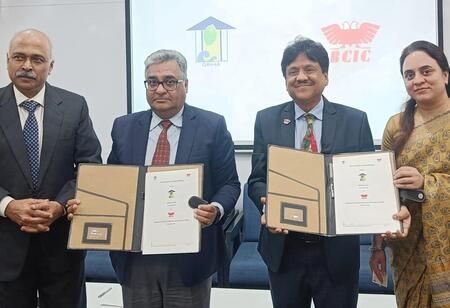
Additionally, an MoU was signed between BCIC and the GRIHA Council, signalling long-term collaboration on sustainable infrastructure and green building adoption in Bengaluru’s industrial and corporate ecosystem. The MoU was formalized between K. Ravi, Senior Vice President, BCIC and Sanjay Seth, Vice President & CEO, GRIHA Council.
Furthermore, during the event, Springer announced the release of ‘Best Practices in Sustainable Built Environments-Case Studies from India and Australia’ a cross-country compilation of applied research and implementation frameworks. The publication was introduced by Lead Editor Dr. Jessica Siva, University of Newcastle, Australia, followed by reflections from co-editors, Dr.Josephine Vaughan, University of Newcastle, Australia, Dr. Saurabh Verma, RICS School of Built Environment, Amity University, India and Dr. Priyanka Kochhar, The Habitat Emprise, New Delhi.
The book highlights the evidence-based urban transformation, something Bengaluru routinely proclaims but has struggled to institutionalise at scale.
Also Read: Reliance Retail Ventures Appoints Jeyandran Venugopal as CEO
The forum underscored that Bengaluru’s sustainability challenges cannot be solved through single-sector interventions. Water management, mobility, construction practices and technology adoption must be aligned with community-level action and governance models capable of sustaining behavioural shifts. Ignoring such integration has historically slowed the city’s resilience efforts.