

Domestic Investors Hold 36 Percent Market Value: SEBI Chairman
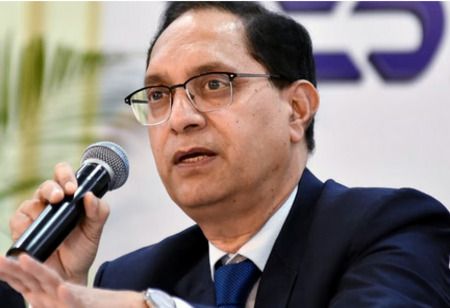
SEBI Chairman Tuhin Kanta Pandey disclosed that the collective ownership of individuals and domestic mutual funds currently accounts for approximately 36 percent of the freely tradable market value of Nifty 50 companies.
This announcement was made during his speech commemorating the 30th anniversary of Nifty 50 at the National Stock Exchange (NSE).
Also Read: Nestlé India Names Prateek Tripathi as Head of IS/IT
Tuhin pointed out that the makeup and success of the Nifty index show the extensive growth and variety in the country's economy over the past thirty years. This time frame symbolized a crucial shift in the ownership distribution of India's stock index.
Tuhin further commented on the substantial growth of the financial sector, noting that its share has risen from approximately 21 percent at the inception to about 38 percent by February 2025.
This notable increase highlights the evolving composition of the index in accordance with the nation's economic direction. The chairman noted that the expansion of the general market ecosystem is also significant.
“As India’s economy expanded and diversified, the composition and performance of the Nifty reflected these changes. Individuals and domestic mutual funds together now hold about 36 percent of the free float market capitalisation of Nifty 50 companies,” he says.
Also Read: UltraTech Cement Elevates Jayant Dua as Managing Director
The chairman observed that the market witnessed the rise of new industries and the expansion of existing sectors during this period. “Over the last 3 decades, we have witnessed the rise of new industries and the expansion of existing ones, from information technology and financial services to telecommunications, consumption-driven businesses, and several new-age sectors,” he says.
It was pointed out that India currently boasts more than 140 million individual investors, marking a consistent trend of household savings being directed towards the capital markets. This rise in investor participation has led to companies listed on the NSE reaching a market capitalization that surpasses 130 percent of the GDP, a stark contrast to the figure of around 35 percent reported in the fiscal year 1995.
Tuhin highlighted the importance of the market infrastructure as a crucial element in the progress made over the past three decades.
He observed that India’s exchanges are currently among the busiest in the world. “Today, India’s exchanges rank among the most active globally. Our markets host one of the largest numbers of listed companies, facilitate a very large number of IPOs each year, and account for one of the highest volumes of derivative contracts traded worldwide,” he says.
The chairman emphasized India's rise as a significant player in the global market, pointing to faster settlement cycles and shorter listing timelines as critical indicators of its efficiency.
Also Read: Siddaramaiah Announces Karnataka Budget For Record 17th Time
“An important feature of our market ecosystem is that while exchanges compete with each other, they also collaborate when it comes to strengthening system-wide resilience,” Pandey says.
“Initiatives such as common contract nodes, interoperability across exchanges, clearing corporations, and the creation of alternate trading arrangements reflect this collaborative approach,” he notes.
The continual advancements indicate a more sophisticated and well-established market environment that facilitates the ongoing incorporation of domestic savings into the formal financial sector.