

Government Approves Rs.3,626 Crore for Pune Metro Phase-2
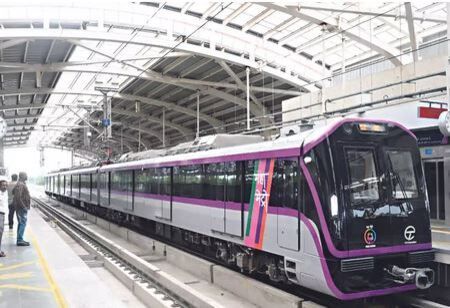
The Union Cabinet, under the leadership of Prime Minister Narendra Modi, has approved the extension of Pune Metro Line 2, a major step forward for urban transportation, with an anticipated expenditure of Rs.3,626 crore to improve connectivity in Pune.
It is anticipated that the project will support the city's rapid growth and enhance the infrastructure of public transportation.
Two major corridors will be covered by the Pune Metro Line 2 extension: Corridor 2A, which connects Vanaz to Chandani Chowk, and Corridor 2B, which links Ramwadi to Wagholi/Vitthalwadi.
The Vanaz-Ramwadi corridor from Phase 1 of the project is being expanded upon.
With 13 stations and a total length of 12.75 kilometers, the new elevated corridors would connect important suburban locations like Chandani Chowk, Bavdhan, Kothrud, Kharadi, and Wagholi. It is anticipated that the construction would be finished in four years.
The Government of India, the Government of Maharashtra, and numerous external bilateral and multilateral agencies will each contribute an equal part of the Rs.3,626.24 crore total anticipated cost of this extension.
In line with Pune's Comprehensive Mobility Plan (CMP), this project intends to improve the city's East-West public transportation system by creating a smooth metro connection between Chandani Chowk and Wagholi.
Also Read: In Gruelling Adversity Rose an Unbeatable Chandra Shekar Gosh
The proposed metro extensions are expected to greatly increase the use of public transit throughout the train network by connecting important technology clusters, business districts, residential regions, and educational institutions. The District Court Interchange Station, which will enable connections between Line 2 and other metro lines, such as Line 1 (Nigdi–Katraj) and Line 3 (Hinjewadi–District Court), is a crucial component of the project. By improving multimodal urban connectedness, this junction would facilitate commuters' city navigation.
Furthermore, buses from Ahilya Nagar and Chhatrapati Sambhaji Nagar will connect at Wagholi, while long-distance buses from Bengaluru and Mumbai will connect at Chandani Chowk. The whole transportation environment would be further enhanced by this connection, which will offer easy access to Pune's metro network.
By providing dependable, quick, and ecologically friendly transportation options, the Pune Metro's extension is anticipated to reduce traffic on important thoroughfares like Paud Road and Nagar Road. According to projections, Line 2's daily ridership will rise to 0.96 lakh by 2027 and 3.49 lakh by 2057. This increase in use highlights how crucial the metro system is to supplying Pune's expanding population's transit needs.
Also Read: India US Collaboration in 6G Tech to Deliver Dividends for Everybody
The project will be implemented under the direction of Maharashtra Metro Rail Corporation Limited (Maha-Metro), which will be in charge of all civil works, electro-mechanical systems, and associated tasks. Topographical analyses and in-depth design conversations are already part of the preliminary preparatory work. The expansion plan is to support sustainable growth across the metropolitan area, improve Pune's urban transportation system, and strengthen the city's economic capacity.