

How to Eliminate Tolerance Stack-Up and Assembly Failure in Complex Machined Components
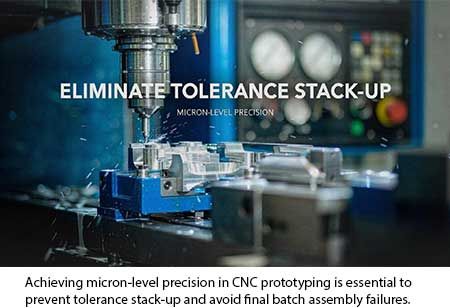 To get rid of tolerance stack-up in complex parts you'll need to abandon 2D linear tolerance chains in favor of 3D datum-based GD&T control. The key is to minimize the secondary positioning errors by using 5-axis single-setup machining, combined with in-situ machine inspections, to achieve micron-level accuracy. In this way, error accumulation is completely eliminated.
Why Do In-Spec CNC Prototypes Often Fail During Final Batch Assembly?
A single qualified prototype is different from regular mass assembly due to big dimensional variations and tolerance statistical distribution. While during rapid CNC prototyping, a part may seem perfect individually but could fail in integrated systems because of dimensional limits.
Major failure reasons include:
- Stress release of residual: internal stresses of aerospace aluminum and engineering plastic are released during machining leading to micro-deformation.
- Datum misalignments: in rapid prototyping teams often ignore datum coincidence i.e. How secondary setups shift references.
- Too tight tolerances: over specifying close tolerances leads to scraps while not handling stack-up.
A cost-efficient prototyping strategy requires front-loading tolerance allocation. Applying statistical tolerancing avoids costly rework later.
How Does 5-Axis Machining Eliminate Datuming Errors Caused by Multiple Setups?
Conventional 3-axis machining typically calls for multiple flips, with each flip adding a new datum shift. This compound error is quite a problem for parts with complex geometries.
The Limitations of 3-Axis Setups
It is a well known fact that each re-clamping can result in alignment variations. For deep cavities, secondary datum errors exceeding ±0.02 mm often means non-viable parts.
Geometric Advantages of 5-Axis Machining
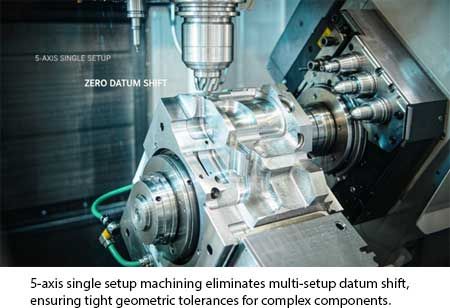
Machines using 5-axis centers can work without any interruptions from re-clamping so that coaxiality and perpendicularity are within ±0.005 mm. This much reduces the possibility of getting errors from setup.
For deep cavities, planning tool paths demands advanced simulation. Professional online custom CNC machining services offer insights. Integrating CNC machining for complex components ensures geometric accuracy.
What Standardized Quality Systems Are Essential to Lock in Micron-Level Repeatability?
Quality systems are nothing but control of the processes like capability indices and the 20°C constant-temperature environments.
Implementing ISO 9001 and AS9100D Standards
ISO 9001 quality management sets the ground, whereas AS9100D adds aircraft specifications with rigorous requirements of exhaustive first-article inspection (FAI)and process validation. Besides that, these standards also require all stages to have written procedures ranging from raw material inspection to final dimensional checking verification.
Advanced Metrology and Process Control
Cutting-edge fabricators set up the use of coordinate measuring machine (CMM) and machine probing on the spot to monitor dimensional changes with the time going. For example, LS Manufacturing sets up fully-equipped-testing laboratory to conduct regular checking through time which stops tolerance drift at the batch level before that affects assembly.
Sourcing precision CNC machining services ensures Vendor Selection Criteria include certified process controls for mission-critical applications.
How Can Multi-Process Manufacturing Maintain Tight Tolerance Loops in Hybrid Assemblies?
The hybrid type of hardware consists of CNC components, stamped sheet metal, and molded cases. It is really tough to get fit tolerances coordinated properly.
Main ideas:
- Cross-Process Datum Alignment: A datum master prevents the building up of the deviation.
- IATF 16949 Defect Prevention: by employing FMEA at automotive level the process design one prevents possible failures.
- ISO 14001 Compliance: chip recycling green machining upkeeps integrity.
Maintaining a balance between structural rigidity and the need for timely deliveries necessitates process parameters linkage between various manufacturing ways. By employing fast delivery CNC machining and ordering custom CNC parts online, manufacturers can be flexible in responding to design alterations which will help the hybrid assemblies to have continuously close tolerance loops through out the product's life cycle.
How Does Upfront DFM and Digital Collaboration Prevent Costly Machining Defects?
LS Manufacturing uses digital platforms for an early intervention. The teams are able to read the tolerances directly thanks to 3D annotated models which also remove the 2D ambiguities.
Automated DFM systems can locate dead zones like sharp corners or thin walls in a really short time. Getting a CNC machining supplier that supports online CNC machining quote and contract manufacturing sourcing you can avoid the risks during quoting, besides which it can save you time and money.
Conclusion
Eliminating stack-up is a systematic endeavor: datum unification, multi-axis optimization, stress control, and rigorous inspection. A GD&T-centric closed loop prevents mass-assembly interference. Facing complex tolerance challenges? Upload CAD models today for DFM analysis and high-precision solutions.
FAQs
What Causes Cumulative Tolerance Stack-Up in Multi-Part Mechanical Assemblies?
Manufacturing causes linear dimensional drift on each part, deviations from different machine setups and residual stress release from the cutting process. All these factors combined and increased during the assembly will eventually lead to interference.
Why Is 5-Axis CNC Machining Superior to 3-Axis Setups for Complex Geometric Tolerances?
With 5-axis machining a workpiece can be completed on all sides with one or the fewest fixtures. In this way datum errors due to the workpiece being moved are eliminated totally. That means you can say the whole part will have accurate hole positions and surface alignments.
How Does Early DFM Analysis Prevent Assembly Failures from Tolerance Accumulation?
DFM review optimizes internal corner radii, reasonably allocates critical mating and non-mating tolerances, and corrects improper datum selections before cutting. This eliminates potential tool interference and structural stress deformation at the design source.
How Do Certifications Like ISO 9001 and AS9100D Impact Real-World Machining Accuracy?
By insisting on a constant-temperature environment and the use of high-precision CMMs as well as a close control of process capability statistics and conducting inspection of the first article, these standards make sure that every series of production pieces maintains a very tight control in mass production.
Why Can Specifying Overly Tight Tolerances Negatively Impact Overall Assembly Yield?
Setting excessively tight tolerances on non-critical surfaces dramatically increases machining stress and scrap costs. The rational approach is to focus on GD&T for critical datums and apply statistical tolerance analysis to balance assembly yield with economic efficiency.
About the Author
Gloria Wu, Director of Technical Support & Solutions, has 15 years of experience in precision manufacturing and multi-axis CNC machining. She leads process breakthroughs for automotive and aerospace components, providing DFM reviews and tolerance optimization for global teams.