

How to Evaluate an Industrial Pump Manufacturer: Foundry, Testing and Traceability Checks
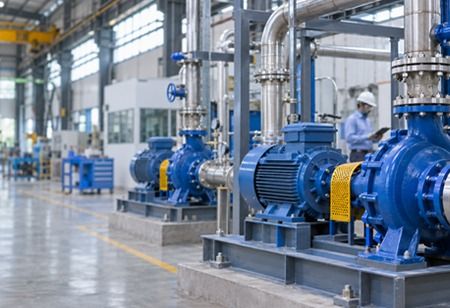 For a plant owner, a pump looks like a small line on the capital budget. A mine, a water utility or a chemical plant may buy dozens of them, and each one seems interchangeable with the next on a quotation sheet. Yet pumps decide uptime. When one fails, the process behind it stops, and the cost of that stop is usually far larger than the price of the pump.
That is why choosing an industrial pump manufacturer deserves the same discipline as choosing any strategic supplier. This article sets out what business leaders and procurement heads should check beyond price: what a quality certificate does and does not prove, why control of casting matters, how factory testing should be documented, and why traceability is a commercial issue. Background on quality standards comes from the Wikipedia entry on the ISO 9000 family. Examples of what a manufacturer can disclose come from BBP, a pump maker that publishes its factory capabilities in detail.
Start with the life of the asset, not the price
BBP describes a pump as a 15-to-25-year asset. Over that span, the purchase price is a small share of what the owner will spend. Energy, spare parts, maintenance labour and unplanned downtime make up the rest, and all of them depend on how well the pump was designed and built.
Framing the decision this way changes the questions a procurement team asks before it signs a long-term supply agreement with any pump manufacturer. Price still matters. But instead of comparing unit prices alone, the team compares the supplier's ability to deliver consistent metallurgy, accurate performance and spare parts many years after the first order. That is a judgement about the manufacturer, not just the product.
Limit: lifecycle thinking only works if the buyer also records running hours and failures, so the next purchase can be judged on evidence.
What an ISO 9001 certificate proves, and what it does not
ISO 9001 is the most common first filter. According to the Wikipedia entry on the ISO 9000 family, third-party certification bodies confirm that organisations meet its requirements, and over one million organisations worldwide hold independent certification. The same article notes that the certification process has been criticised, and that the link between certification and better financial performance has been studied without proof of direct causation.
For a buyer evaluating a pump manufacturer, the conclusion is simple. A certificate shows that a documented quality system exists and was audited. It does not, on its own, prove that a particular casting is sound or that a particular pump meets its curve. Ask for the certificate number, check it with the issuing body, and then look for evidence at the product level.
Duration is one useful signal. BBP, for example, states that its quality system has been certified continuously since 1990. A long, unbroken record suggests the system is part of how the factory runs rather than a document prepared for one tender.
Foundry control: casting and heat treatment
A pump's life is decided largely in the foundry. Impellers, casings and wear parts are cast, and defects such as porosity, inclusions or uneven hardness only show up later as early wear or cracking. Many suppliers buy castings from outside foundries, which adds a hand-off where alloy and quality can drift.
Buyers can ask directly which processes happen in-house. BBP's disclosure is a good example of the level of detail worth requesting: its casting processes include resin sand, coated sand and lost foam, and its heat-treatment workshop houses four curve-controlled electric furnaces with computer-driven temperature regulation. A supplier that can describe its own melting, moulding and heat treatment is easier to hold accountable than one that cannot name its foundry.
Risk: a factory tour that shows only machining and assembly may be hiding the part of the process that matters most.
Factory testing that can be audited
Performance claims should be tested, not promised. International standard ISO 9906 defines acceptance grades for pump hydraulic tests, and buyers can specify which grade they need. BBP states that ISO 9906 Grade 1U / 2B hydraulic acceptance tests are performed on every unit, and that spectrometric alloy verification and non-destructive flaw detection are completed before each pump's record is closed.
The commercial point is that a test report turns a sales promise into evidence. Specify the acceptance grade in the purchase order, ask for the test curve tied to each serial number, and arrange witness testing for critical pumps. These steps cost little compared with discovering after installation that a pump falls short of its duty point.
Traceability as a business safeguard for buyers
When a pump fails early, the owner wants to know why, and whether the same problem sits in the other units on site. That depends on traceability. BBP says every pump leaving its factory carries a unique identification code, and that the code traces back to the personnel responsible for casting, machining, assembly, inspection, painting and shipping.
Records at that level allow a failure to be traced to a heat lot or a process step rather than guessed at. For a buyer with a fleet of pumps, that turns a warranty dispute into a targeted inspection, and it protects the business from replacing good equipment along with bad.
A supplier audit checklist for an industrial pump manufacturer
Turning these points into a questionnaire makes suppliers comparable. Send the same list to every shortlisted factory and score the answers before any commercial discussion starts.
- Check the ISO 9001 certificate number with the issuing body and record how long the system has been certified without a break.
- Ask which casting, heat treatment and machining steps happen in the supplier's own foundry and factory, and which are bought in.
- Specify the ISO 9906 acceptance grade in the purchase order and request the test curve tied to each serial number.
- Review a sample traceability record: from one finished pump, can the supplier name the heat lot and the inspector?
- Compare spare-parts lead times for the wear parts you will replace most often, and test the answer on the first order.
- Arrange a witness test or factory visit for critical pumps, and keep the findings with the contract file.
A supplier that answers every line with documents, not adjectives, is usually the one whose pumps will be easiest to support over their full life.
Limits and risks of any supplier evaluation
No checklist replaces operating experience. A manufacturer can pass every document review and still supply a pump that is wrong for the duty because the buyer's data was incomplete. Accurate flow, head, liquid properties and operating hours remain the buyer's responsibility.
Distance and support also matter. A capable factory on another continent still needs local stock, responsive engineering contact and clear spare-parts lead times. Ask how parts reach your site, how long that takes, and who answers the phone when a pump stops at night.
Leadership teams that want to see what a detailed factory disclosure looks like can review an industrial pump manufacturer that publishes its foundry, testing and traceability practices, and use it as a benchmark for their own supplier questionnaire. The goal is not to find the cheapest pump, but the supplier whose evidence will still hold up when the pump is ten years old.