

India, Japan Ink Quantum Technology, Healthcare Cooperation Deal
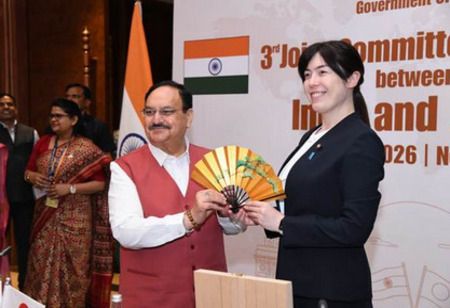
During a high-level bilateral meeting held in the national capital, India and Japan fortified their strategic collaboration in the realms of science and technology by exchanging significant agreements focused on healthcare innovation and emerging technologies.
The Ministry of Science & Technology conducted a meeting with Japan’s Minister for Science and Technology Policy and Minister of State for Space Policy, Kimi Onoda, as well as the Union Minister of State for Science & Technology and Earth Sciences, Jitendra Singh.
The dialogue broadened collaboration in crucial and emerging technologies, marked by the signing of a Memorandum of Cooperation (MoC) in the health and medical devices sector.
This agreement involved the Japan Agency for Medical Research and Development (AMED), the Indian Council of Medical Research (ICMR), and India’s Department of Science and Technology (DST).
An agreement, known as a Letter of Intent (LoI), concerning cooperation in Quantum Science and Technology was formalized between Japan’s Cabinet Office and India’s Department of Science and Technology (DST).
This event signifies a pivotal advancement towards joint efforts in the field of next-generation technologies, encompassing quantum computing and secure communication systems.
During his remarks at the meeting, Singh stated that India and Japan possess an inherent synergy in the realm of science and technology. He observed that Japan's advanced technological prowess combined with India's pool of skilled talent offers substantial opportunities for collaborative innovation.
Furthermore, he mentioned that the partnership between the two nations has embarked on a "new phase" subsequent to Prime Minister Narendra Modi's visit to Japan in 2025. The Japanese minister commended India's swift economic expansion and innovative ecosystem, particularly highlighting the extensive integration of artificial intelligence across various sectors.
She further emphasized Japan's capabilities in the fields of advanced manufacturing and quantum technologies, conveying optimism regarding enhanced collaboration between the two nations. The two parties deliberated on enhancing collaboration under India's National Quantum Mission, encompassing areas such as quantum computing, communication, sensing, and materials research.
They also considered broadening researcher exchange programs, joint innovation platforms, and industry internship opportunities. In the realm of healthcare, both nations reached a consensus to strengthen cooperation by engaging in collaborative research endeavors, implementing capacity-building programs, and establishing funding support strategies to expedite the advancement of medical technologies.
The interaction further reaffirmed the mutual dedication of India and Japan towards enhancing collaboration in science and technology, as an integral component of their expansive vision for a free, open, and innovation-led Indo-Pacific region.