

Indigenous Tech Needed for Energy Security: Union Minister Reddy
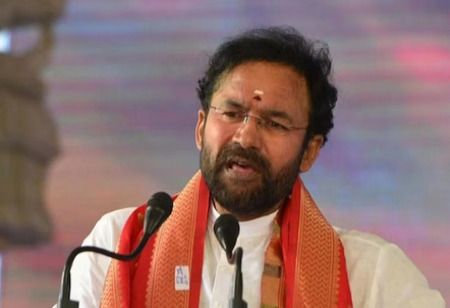
According to Union Coal and Mines Minister G Kishan Reddy, India's greatest opportunities exist in tackling significant challenges in areas like energy, mining, and healthcare, emphasizing that indigenous innovations could help benefit the whole globe.
Speaking at the 17th convocation of the National Institute of Technology (NIT) Raipur, the minister highlighted that India's higher education system has experienced extraordinary growth and modernization in the last ten years under Prime Minister Narendra Modi's leadership.
Also Read: Zomato to Roll Out 'Mehmaan Mode' to Hide Food Prices
The Union minister stated that initiatives like the Prime Minister’s Early Career Research Grant, Partnerships for Accelerated Innovation and Research, Artificial Intelligence for Science and Engineering, and the Critical Raw Materials Research Program have created fresh opportunities for emerging researchers.
Pointing to the increasing worldwide need for essential minerals utilized in electric vehicles, renewable energy, semiconductors, batteries, and defense technologies, Reddy noted that mining poses a significant challenge. He mentioned that through the National Critical Mineral Mission, India has been focused on attaining self-sufficiency throughout the supply chain, encompassing the creation of innovative technologies and processing plants.
He addressed the gathering, stating that it concerns national security and the sovereignty of Bharat; the technologies you create will represent some of the greatest contributions to the motherland.
Also Read: HDFC Securities Names Abhishek Mehrotra as CDO
Emphasizing India's advancements in technology and innovation, Reddy stated that commercial manufacturing and delivery of Made-in-India semiconductor memory modules commenced at the Micron plant in Sanand, Gujarat, in February of this year. Patent applications in the nation rose from under 15,000 ten years ago to almost 1.75 lakh last year, with India becoming the world's third-largest startup ecosystem, he noted.
Reddy stated that India has significantly developed its higher education infrastructure since 2014, with the count of universities rising from approximately 700 to over 1,100. The Gross Enrolment Ratio for higher education rose from 23.7 percent in 2014-15 to approximately 29 percent, and there was also growth in female enrolment, he mentioned.
He also mentioned that educational institutions are offering programs in new areas like artificial intelligence, semiconductors, advanced manufacturing, and green technologies to equip students for future job prospects and international competition. Reddy also stated that artificial intelligence will not replace human skills but will enhance them by handling mundane tasks, allowing individuals more time to think, innovate, and tackle bigger issues.
Also Read: Banas Dairy to Expand French Fries Capacity to Five Tonnes
He encouraged graduating students to engage in research, design, and innovation in India, working to create technologies that can compete on a global scale.
He tasked students with pinpointing a specific real-world issue in areas like energy, mining, healthcare, or sustainability and dedicating themselves to developing a solution within the following three years.
He also urged students to find a balance among their careers, health, mental wellness, and personal relationships.