

Indus Towers and IIT Madras Announce Partnership
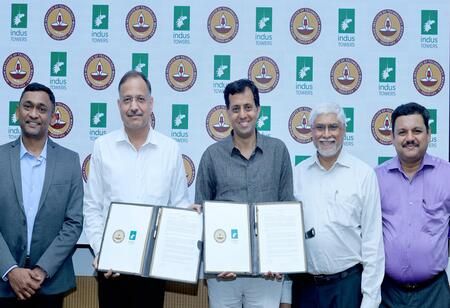
In a significant development for the telecom infrastructure industry, Indus Towers Limited, among the largest telecom tower firms globally, has collaborated with the Indian Institute of Technology Madras (IIT Madras) to lead research on Glass Fibre Reinforced Polymer (GFRP) structural components.
This partnership represents a unique industry-academia effort to investigate the structural, economic, and environmental benefits of GFRP applications.
This program is a key element of Indus Towers’ main Corporate Social Responsibility (CSR) initiative, Pragati, which aims to promote sustainable innovation and inclusive development. Indus Towers has partnered to back innovative research at IIT Madras focused on creating lightweight, corrosion-resistant, and high-performance substitutes for traditional steel structures.
Anil Gupta, Chief Technology & Delivery Officer at Indus Towers says, “This partnership with IIT Madras is a bold step toward redefining the material science landscape for various industries working on GFRP. GFRP offers a transformative opportunity not only structurally sound and cost-effective but also aligned with our sustainability goals. As we look to the future, our focus is on engineering solutions that are resilient, scalable, and environmentally responsible. This initiative is a testament to our commitment to innovation that serves both business and society.”
Also Read: Piyush Goyal: Transformations in Navigating International Trade Relationships
GFRP is gaining global traction as a next-generation material for various industry infrastructure due to its superior strength-to-weight ratio, corrosion resistance (especially in coastal and high-exposure environments), and low maintenance requirements. Its adaptability in design, ease of transportation and installation, and potential for reuse make it a compelling choice for future-ready infrastructure.
Also Read: 5 Interesting CMO Appointments in August 2025
IIT Madras will lead rigorous investigations into the mechanical performance, durability, and lifecycle sustainability of GFRP materials. The research will help establish robust design and safety standards for applications, potentially setting new benchmarks that will help other industries including Telecom.
This collaboration underscores Indus Towers’ broader vision of enabling a digitally connected and sustainable India, while reinforcing its leadership in responsible infrastructure development.
Prof. Ravindra Gettu, Professor-in-charge, IIT Madras says, “The grant has enabled us to assess the material and structural potential of glass fibre-reinforced polymers for a range of applications, such as telecommunication towers, scaffolding, staircases and ladders, roofing elements and framing systems for partition walls and dry cladding. The research will lead to models of durability, structural performance and sustainable applications.”
Also Read: Engineer’s Day 2025: Celebrating Five Most Renowned Engineers
Prof. Ashwin Mahalingam, Dean – Alumni & Corporate Relations says, “IIT Madras’ partnership with Indus Towers stands testimony to how industry-academia collaborations take research from the laboratory to market ready, socially and economically impactful solutions. The GFRP research project with Indus Towers exemplifies this spirit, as it seeks to deliver sustainable, durable and future-ready alternatives for India’s telecom infrastructure.”