

PM Modi Unveils Five-Sector India Plan Before European Giants
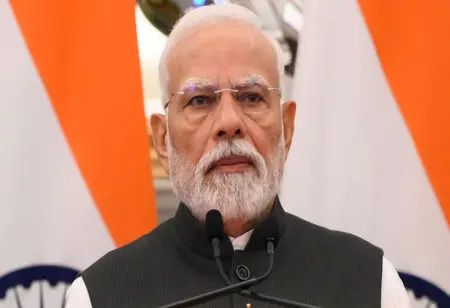
According to reports, India's Prime Minister Narendra Modi entered a space crowded with the chairpersons and CEOs of Europe's leading companies and posed a straightforward challenge: pledge one new, courageous commitment to India in the next five years.
The event was the European Round Table for Industry, a prominent business forum in Europe, co-hosted by Swedish Prime Minister Ulf Kristersson and European Commission President Ursula von der Leyen.
It represented one of the most important diplomatic-business interactions between India and Europe in recent times, and Modi utilized every moment of it.
The ERT session attracted a distinguished range of European industries from various sectors. Vodafone, Ericsson, Nokia, and Orange represented telecom and digital. Technology and semiconductors introduced ASML, NXP, SAP, and Capgemini.
Energy and clean technology included ENGIE, TotalEnergies, Shell, and Umicore among the participants. Infrastructure, transport, and production featured Volvo Group, Maersk, Airbus, Saab, ArcelorMittal, and Heidelberg. AstraZeneca, Roche, Merck, Philips, Nestlé, and Unilever represented the healthcare and life sciences sectors.
Also Read: West Asia Conflict Disrupting Shipments & Inputs for Indian Firms
PM Modi outlined a focused roadmap for stronger India-Europe industrial cooperation, urging participating companies to commit to five key sectors: telecom and digital infrastructure, including the transition from 5G to 6G, AI-powered networks, and digital inclusion; AI, semiconductors, and deep-tech manufacturing to position India as a global end-to-end technology hub; green transition and clean energy covering hydrogen, electric vehicles, energy storage, and decarburization; infrastructure, mobility, and urban transformation spanning aerospace, green steel, logistics, and defence; and healthcare and life sciences, including vaccines, cancer care, digital health, and medical devices.
Also Read: PM Modi Led Manufacturing Initiatives: Make in India, PLI & More
He discussed openly India's reform progress over the last 12 years, including GST, the Insolvency and Bankruptcy Code, corporate tax reductions, Production-Linked Incentive programs, FDI liberalization, and a notable decrease in the regulatory compliance load.
Also Read: IIMA Effect: 5 Alumni Leaders Driving Impact Across Industries
He additionally highlighted India's structural assets: the fastest-growing major economy in the world, a population of 1.4 billion, and the third-largest global startup ecosystem.