

AI Advantage: Transforming Aerospace, Defence and Space
Artificial Intelligence (AI) is rapidly emerging as a transformative force across industries, and the aerospace, defence and space sectors are among those poised to benefit significantly from its adoption. From product design and engineering to manufacturing, maintenance, repair and overhaul (MRO), AI is creating opportunities to improve operational efficiency, accelerate innovation, strengthen quality assurance and enhance strategic capabilities.
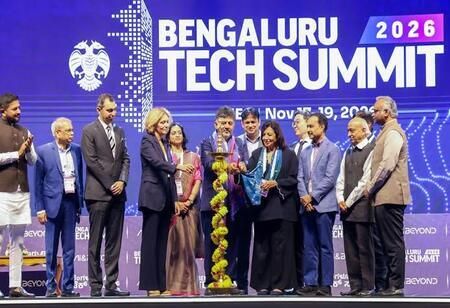
These developments were explored during an insightful panel discussion titled “Aerospace and Defence: The AI Advantage”, at Bangalore Tech Summit 2026, which brought together industry leaders to examine how AI is reshaping the sector and what organisations must do to remain competitive in an increasingly technology-driven environment.
The session was moderated by Rahul Mathur, CEO, HET Group. The distinguished panel featured Dr. Alon Stopel, Chief Scientist for Innovation and Chairman, Board of Israel Innovation Authority (IIA) Ministry of Innovation, Science and Technology, Government of Israel, Binu Krishnankutty, Managing Director, Collins Aerospace and Raghuram S.K., Chief Operating Officer, SASMOS HET Technologies.
The discussion focused on two important dimensions of AI adoption: its application across industrial processes, including design, manufacturing and MRO, and its role in developing next-generation products, technologies and solutions.
Aerospace and Defence: The Next Decade of Intelligent Transformation
The aerospace and defence industry is undergoing a significant transformation, driven by rapid technological advancements and the growing adoption of artificial intelligence. The convergence of advanced engineering, autonomous systems, digital technologies and next-generation materials is creating new opportunities across both defence and civilian applications. As the industry evolves, innovation, systems integration and technological capabilities will play a critical role in shaping its future.
Dr. Alon Stopel emphasized the importance of distinguishing between technological capabilities and the systems in which they are deployed. According to Dr. Alon, many foundational technologies used in aerospace and defence are equally relevant to civilian industries. Technologies such as autonomous systems, wearable electronics, augmented reality, advanced materials and energy solutions have applications extending well beyond their original sectors.
For instance, autonomous aerial systems can support defence surveillance, urban monitoring and agricultural applications. Similarly, wearable technologies developed for military personnel can find applications in sports, healthcare and personal performance monitoring. Augmented reality systems designed for pilots can also be adapted for civilian use.
This convergence of technologies presents an opportunity for aerospace and defence companies to leverage innovations across industries.
Dr. Alon further highlighted that the sector's competitive advantage would increasingly depend on systems integration, engineering expertise and the ability to combine multiple technologies into sophisticated solutions.
India’s Aerospace Manufacturing Journey and the Role of AI
The discussion then shifted to India's growing position in the global aerospace and defence ecosystem.
Sharing the perspective of India's aerospace manufacturing industry, Binu Krishnankutty, Managing Director, Collins Aerospace, highlighted India's remarkable transformation from basic manufacturing capabilities to sophisticated engineering, product development and end-to-end manufacturing operations.
Binu Krishnankutty described how Collins Aerospace had grown from a small team of seven employees approximately 27 years ago to a workforce of more than 7,500 professionals.
This journey reflects the broader evolution of India's aerospace manufacturing ecosystem. What began with relatively simple manufacturing processes has developed into an integrated industrial capability encompassing design, engineering, manufacturing and supply chain management.
An important milestone in this journey has been the increasing localisation of the supply chain, with approximately 40% of the components entering certain products being sourced domestically. The expansion into MRO services further strengthens this ecosystem by enabling organisations to participate across the entire product lifecycle.
However, Binu Krishnankutty stressed that aerospace manufacturing requires a strong technical foundation. Building capabilities in this highly specialised industry involves significant investment in workforce training, process development and systems engineering.
Traditionally, transitioning a new aerospace product into manufacturing could take eight to ten years. Today, organisations are working towards significantly shorter development and industrialisation cycles.
AI is expected to accelerate this transformation.
One of the biggest opportunities, according to Binu Krishnankutty, lies in connecting information that currently exists across engineering, manufacturing, procurement, supply chains and maintenance operations. Aerospace programmes typically involve global stakeholders, multiple suppliers and geographically distributed teams. Bringing together their knowledge and data can be time-consuming.
Building the Foundation for AI
A key theme emerging from the discussion was that successful AI adoption depends on much more than access to advanced algorithms or computing capabilities. Organisations must first establish a strong digital foundation.
Binu Krishnankutty highlighted the importance of developing connected manufacturing environments through Industry 4.0 initiatives. Collins Aerospace's Factory of the Future, inaugurated the previous year, was designed around connectivity and the systematic collection of data across operations, people, processes and quality functions.
This structured data environment provides the foundation for deploying AI tools effectively.
Binu Krishnankutty explained that AI can only deliver meaningful insights when it has access to reliable, contextualised and well-organised information. Without a strong understanding of products, processes and systems engineering, AI applications risk generating outputs that lack the necessary industrial context.
India is also emerging as an important contributor to this transformation. Collins Aerospace's digital engineering teams have expanded significantly over the past few years, reflecting the growing role of Indian talent in global AI adoption, research and development.
The opportunity is particularly significant for India, given its expanding engineering capabilities and increasing participation in global aerospace programs.
Also Read: 10 Indian Solar Manufacturing Leaders Shaping India’s Renewable Energy
Data Ownership, Intellectual Property and Cybersecurity
As aerospace organisations become increasingly data-driven, protecting proprietary information and intellectual property is becoming a strategic priority.
Moderator Rahul Mathur raised an important question around how organisations can securely manage internally generated data while connecting with external stakeholders, suppliers and customers to unlock greater efficiencies.
Responding to the question, Raghuram S.K., Chief Operating Officer, SASMOS HET Technologies, emphasised that AI models themselves are gradually becoming commoditised. As access to advanced AI models becomes more widespread, the real competitive advantage will come from an organisation's proprietary historical data, specialised knowledge and accumulated process expertise.
Raghuram S.K. highlighted that this knowledge, built over years of engineering and manufacturing experience, is difficult for competitors to replicate.
Organisations must therefore focus on developing structured knowledge repositories that can support domain-specific AI applications. Their ability to train and contextualise AI systems using proprietary information could become a major differentiator in the marketplace.
However, Raghuram S.K. also pointed out that this advantage may evolve as AI technology matures and more specialised foundation models become available.
Data governance will consequently become critical. Organisations must carefully determine where their information is stored, who can access it and how it is shared across business units and external partners.
The discussion also highlighted the importance of sovereign AI capabilities, particularly in aerospace and defence, where national security, confidentiality and intellectual property protection are essential.
Raghuram S.K. referred to the growing importance of sovereign AI infrastructure and domestic computing capabilities, highlighting how countries such as India are investing in developing their own technological ecosystems. Such initiatives will help countries maintain greater control over strategically important technologies and sensitive information.
Also Read: Meet 10 Indian Chemical Industry Pioneers Driving Innovation & Growth
India-Israel collaboration
One of the most significant aspects of the discussion was the potential for greater collaboration between India and Israel in aerospace, defence and advanced technologies.
Responding to moderator Rahul Mathur's question about opportunities for cooperation between large corporations, mid-sized businesses and startups, Dr. Alon Stopel highlighted the growing relationship between the two countries.
Dr. Alon noted that cooperation already exists between major Indian and Israeli defence companies, supported by government-level engagement.
Dr. Alon also discussed the India-Israel Industrial R&D and Technological Innovation Fund (I4F), which has facilitated collaborative innovation between companies from both countries.
Referring to recent developments, Dr. Alon mentioned six additional collaborations involving Indian and Israeli companies that had been considered through the initiative.
However, Dr. Alon believed that the existing level of cooperation represented only the beginning of a much larger opportunity.
Dr. Alon Stopel proposed expanding the funding available for bilateral innovation and developing collaborative research programmes that bring together companies, startups and academic researchers from both countries.
Such programmes could focus on early-stage research and development in emerging areas such as physical AI, advanced computing and other next-generation technologies.
Dr. Alon also suggested establishing joint laboratories and pilot projects to demonstrate technologies at higher Technology Readiness Levels (TRLs), helping move innovations from research environments towards practical industrial applications.
An important dimension of this collaboration would be strengthening technological sovereignty and strategic independence.
Both India and Israel have strong incentives to develop indigenous capabilities in areas such as AI, quantum technologies and advanced engineering. By combining their respective strengths, the countries can accelerate innovation while creating technologies that serve their national strategic interests.
Also Read: Beyond Automation: How India is Building its AI Future
The Road ahead
Several priorities emerged from the conversation, highlighting the importance of adopting a holistic approach to AI integration across the aerospace and defence industry. AI can accelerate product development by reducing the time required to assimilate engineering knowledge, improving design processes and enabling faster industrialisation. Building intelligent manufacturing ecosystems through connected factories and structured operational data will create opportunities for predictive insights, smarter production and improved operational efficiency.
At the same time, strengthening data security through intellectual property protection, data sovereignty and robust cybersecurity frameworks will be essential to ensuring the safe and responsible adoption of AI. The panellists also emphasised the need to develop specialised talent by bringing engineering and digital capabilities together to support next-generation aerospace technologies. Furthermore, encouraging international partnerships between companies, research institutions and governments will play a crucial role in accelerating innovation, sharing expertise and developing advanced technological capabilities.
Conclusion: AI as a Strategic Advantage for Aerospace and Defence
From India's growing manufacturing capabilities to the emergence of intelligent factories, sovereign AI infrastructure and international research partnerships, the sector is entering an important phase of transformation.
The future competitive advantage of aerospace and defence companies will not depend solely on who has access to the most advanced AI models. It will depend on who can combine proprietary data, engineering expertise, digital infrastructure and strong industry partnerships to create meaningful business outcomes.
For India, the opportunity is particularly significant. Its expanding engineering talent pool, growing manufacturing ecosystem and increasing participation in global aerospace programmes provide a strong foundation for becoming a major contributor to next-generation aerospace and defence technologies.