

Manufacturing: The Engine Driving India’s Industrial Leadership
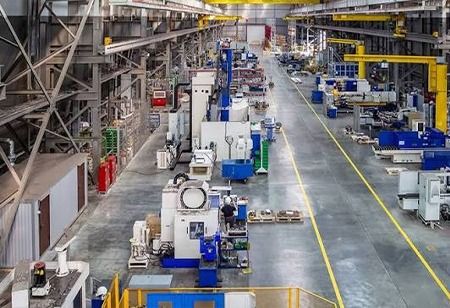
India’s manufacturing sector is entering a new era of growth, driven by policy reforms, technological innovation, global supply chain shifts, and rising investments. This article explores how initiatives such as Make in India and PLI schemes, along with advancements in AI, automation, and Industry 4.0, are transforming India into a global manufacturing hub. Featuring insights from industry leaders, the article highlights opportunities across electronics, pharmaceuticals, automobiles, and textiles while examining the role of skills, sustainability, and digital transformation in shaping India’s industrial future.
India stands at the threshold of a historic industrial transformation, driven by a rapidly expanding economy, strategic geographic advantages, a young workforce, and an increasingly favourable business ecosystem. The country is emerging as one of the world’s most promising manufacturing destinations. Valued at over $1.5 trillion, India’s manufacturing sector is projected to reach approximately $3.17 trillion by 2035, growing at a CAGR of 7.5 percent, supported by policy reforms, rising domestic demand, export growth, technological adoption, and growing investor confidence.
As global companies diversify supply chains under the China+1 strategy, India is gaining prominence as a reliable hub for large-scale production, innovation, and investment. Beyond becoming a low-cost manufacturing base, the nation is advancing towards technology-driven, sustainable, and advanced manufacturing.
The government’s goal of raising manufacturing’s GDP contribution to 25 percent and achieving $1 trillion in exports highlights the sector’s critical role in India’s economic growth and long-term development.
Manufacturing for Tomorrow
The global manufacturing landscape is undergoing a fundamental transformation. Digitalization, artificial intelligence, automation, Industry 4.0 technologies, robotics, and sustainability are redefining how products are designed, manufactured, and delivered.
India’s opportunity lies in combining its traditional strengths of engineering talent, cost competitiveness, and large-scale workforce with advanced technology capabilities. By accelerating digital adoption, improving infrastructure, strengthening research and development, and encouraging collaboration between industries and institutions, India can emerge as a leader in next-generation manufacturing.
 Highlighting the importance of collaboration between industry and government, CA K Ravi, President of Bangalore Chamber of Industry and Commerce (BCIC), says, “As we embark on this new journey, our endeavour will be to strengthen industry-government collaboration, promote innovation, support MSMEs, encourage global partnerships and create greater opportunities for businesses across Karnataka.”
Adding a technology perspective to India’s manufacturing opportunity, Bharat Lingam, CEO, [x]cube LABS, highlighted that the country’s next phase of industrial growth will depend on transforming scale into precision and intelligence.
“India's biggest opportunity lies in converting existing scale into precision. The country already has the workforce, the domestic demand, and policy momentum through Make in India and the PLI scheme. What is opening up now is deeper participation in high-value segments such as electronics components, semiconductors, EVs, and pharmaceuticals, rather than final assembly alone,” says Bharat.
He further emphasised that digital transformation will become a key differentiator for Indian manufacturers.
“The less obvious opportunity is digital. Manufacturers pairing new capacity with AI-driven quality control, predictive maintenance, and connected shop floors get more output per rupee invested than those relying on capacity alone,” Bharat adds.
India’s Manufacturing Moment
India’s manufacturing advantage is supported by several structural strengths that few economies possess simultaneously. A stable policy environment, one of the world’s largest working-age populations, expanding digital infrastructure, improving logistics networks, and a rapidly growing domestic market provide a strong foundation for industrial growth.
Over the past decade, initiatives such as the Goods and Services Tax (GST), Production Linked Incentive (PLI) schemes, National Logistics Policy, PM Gati Shakti, and Ease of Doing Business reforms have significantly improved the manufacturing ecosystem. These measures have reduced operational barriers, encouraged investment, streamlined supply chains, and strengthened India’s position among global manufacturers.
The country’s digital transformation has further accelerated industrial modernization. Smart factories, AI-powered quality control, predictive maintenance systems, cloud-enabled manufacturing platforms, and data-driven supply chains are helping companies improve productivity while meeting global standards.
At the same time, sustainability has become a defining factor in industrial competitiveness. Manufacturers are increasingly adopting renewable energy, energy-efficient production systems, circular economy practices, and responsible manufacturing processes to align with evolving global expectations.
Manufacturing as a Growth Engine
History has demonstrated that manufacturing capability is closely linked with economic prosperity. Every major industrial economy has built its growth story on a strong manufacturing foundation. Beyond creating jobs, manufacturing strengthens exports, drives innovation, enhances technological capability, and improves economic resilience.
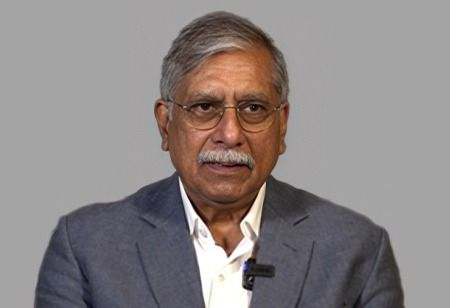 Sharing his perspective on India’s manufacturing journey, F R Singhvi, Joint Managing Director of Sansera Engineering Limited, highlighted the sector’s importance in shaping India’s future.
“India has never been better positioned than it is today—with political stability, a young workforce, global trust, and digital transformation shaping its future. But the next twenty years will decide whether we truly become a developed nation. No country has achieved that without a strong manufacturing base. Services create wealth, but manufacturing creates jobs, innovation, exports and national security.”
He further says, “If India aims to become a $ 10 trillion economy, manufacturing must grow significantly. While our entrepreneurs, engineers, and MSMEs have shown remarkable resilience and earned global trust, we must overcome our dependence on imports, invest more in research, and strengthen industry-academia collaboration.”
India’s journey towards becoming a developed economy will depend on its ability to expand domestic production, create globally competitive enterprises, invest in innovation, and develop resilient supply chains.
Electronics Manufacturing Boom
Among India’s strongest manufacturing success stories is electronics production. Over the past decade, the country has transformed from being heavily dependent on imports to becoming one of the world’s largest electronics manufacturing destinations.
Mobile manufacturing has witnessed unprecedented growth, expanding from just two manufacturing units a decade ago to nearly 300 units today. Mobile phone exports have grown significantly from around Rs.1,500 crore to nearly Rs. 2 lakh crore, reflecting India’s emergence as a major global electronics hub.
The country’s dependence on imported mobile phones has also declined sharply, with India moving from an import-dependent market to becoming the world’s second-largest mobile phone manufacturer.
The electronics manufacturing ecosystem has benefited from significant foreign investment, with more than $ 4 billion in FDI attracted since FY2020-21. A substantial portion of this investment has come through companies supported by the PLI scheme.
According to Bharat Lingam, the next stage of growth will depend on moving beyond assembly and creating deeper value chains.
Also Read: Piyush Goyal: Transformations in Navigating International Trade Relationships
“Make in India built the appetite for scale; PLI provided a financial mechanism to act on it,” he said.
“The manufacturers that paired new PLI-backed plants with digital operations, real-time quality data, connected supply chains, and automated compliance captured more of the incentive's value and are now winning export orders on merit rather than price alone,” Bharat adds.
Pharma: Powering Global Health
India’s pharmaceutical industry continues to be a global success story, combining scale, affordability, and innovation. Ranked third globally by volume and fourteenth by value of production, the sector supplies more than 50 percent of global vaccine requirements and nearly 40 percent of generic medicines consumed in the United States.
 The industry is projected to grow substantially, reaching $ 130 billion by 2030 and potentially expanding into a $ 450 billion market by 2047.
Government initiatives such as the Pharmaceutical PLI scheme and Strengthening of Pharmaceutical Industry program are encouraging investments in advanced medicines, modern manufacturing facilities, research capabilities, and quality improvements.
Through these efforts, India is strengthening its position as the “Pharmacy of the World” while expanding its presence in high-value pharmaceutical manufacturing.
The Automotive Transformation
India’s automotive industry remains a cornerstone of manufacturing growth. Contributing approximately 7.1 percent to GDP and nearly 49 percent of manufacturing GDP, the sector continues to drive industrial expansion.
During FY25, India produced more than 3.10 crore vehicles across passenger vehicles, commercial vehicles, three-wheelers, two-wheelers, and quadricycles.
The sector is undergoing a major transformation with electric vehicles, connected mobility solutions, battery manufacturing, and advanced manufacturing technologies reshaping the future of mobility.
With its engineering capabilities, supplier ecosystem, and growing domestic demand, India has the potential to become a global leader across the automotive value chain.
Textiles: Creating Inclusive Growth
India’s textile and apparel industry remains one of the country’s most employment-intensive manufacturing sectors. Contributing around 2.3 percent to GDP, 13 percent to industrial production, and 12 percent to exports, the sector continues to play a critical role in economic development.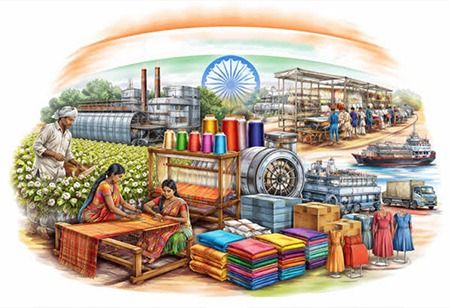
The industry is expected to grow into a $ 350 billion market by 2030, creating millions of employment opportunities.
Employing more than 45 million people directly, including women and rural workers, textiles represents one of India’s most inclusive industries. Nearly 80 percent of the sector operates through MSME clusters, supporting entrepreneurship and regional development.
Also Read: PM Modi Led Manufacturing Initiatives: Make in India, PLI & More
The government’s PM MITRA Parks initiative aims to accelerate textile manufacturing by attracting investments and creating large-scale employment opportunities.
According to Ajay Ajmera, Founder & CEO, Ajmera Fashion Limited, “India's emergence as a global manufacturing hub is being powered by its vast domestic market, young workforce, strong entrepreneurial ecosystem, and global supply chain diversification, supported by initiatives such as Make in India, GST, and the Production Linked Incentive (PLI) schemes.”
 Drawing from his experience in Surat's textile industry, Ajmera notes that international buyers increasingly view India as a preferred sourcing destination, but long-term competitiveness will depend on delivering consistent quality, compliance, speed, and sustainability rather than cost alone.
He believes India's textile sector has the potential to move beyond being a low-cost manufacturing base to building globally recognised Indian brands by combining traditional craftsmanship with modern manufacturing capabilities. To sustain this momentum over the next decade, he emphasises the need for stable policies, simpler regulations, lower logistics and energy costs, stronger domestic value chains, and industry-led skilling in automation, AI, and quality management.
"India should not aim to be only the world's factory. We should aspire to be the world's most trusted manufacturing partner," Ajay says.
Building Trust in Global Supply Chains
As global supply chains evolve, India has an opportunity to become a preferred manufacturing partner. However, future competitiveness will depend not only on production capacity but also on transparency, reliability, and digital visibility.
Bharat Lingam highlighted that global buyers increasingly seek connected and transparent manufacturing ecosystems.
“Global buyers diversifying beyond a single country want two things: capacity they can trust, and visibility into that capacity,” Bharat says.
“Buyers increasingly want digital visibility into supplier operations: real-time production data, quality traceability, ESG reporting, without relying on periodic audits,” Bharat adds.
According to him, manufacturers that combine physical infrastructure with digital intelligence will gain a stronger competitive advantage.
“Becoming a trusted partner, rather than a cost hedge, is the real prize,” Bharat says.
Building Skills for the Future
 Manufacturing growth is ultimately driven by people. As factories become increasingly automated, developing a digitally skilled workforce will determine India’s competitiveness.
Bharat highlighted the importance of industry-academia collaboration.
“The most urgent gap is digital: workers who can operate alongside automation, read sensor data, and use AI tools on the shop floor, not just IT graduates.”
He added that practical learning models are essential. “We have found real value in structured internships and live project work with engineering colleges, where students solve an actual production or data problem rather than a textbook case.”
Also Read: 5 FTAs Strengthening India’s Growth Prospects in 2026 & Beyond
The Road Ahead: From Growth to Global Leadership
India’s manufacturing journey has reached a defining stage. Supported by policy reforms, technological advancement, infrastructure development, and global supply chain realignment, the country has a historic opportunity to emerge as one of the world’s leading manufacturing economies.
Looking towards 2035, Bharat Lingam believes India’s manufacturing ambitions must extend beyond production volumes. “India should be known as a trusted designer, not just a reliable assembler, owning meaningful IP and component-level manufacturing rather than importing the highest-value parts. ”
Bharat adds, “The smart factory should become the default, not the exception. AI-driven quality control, predictive maintenance, and connected supply chains should be standard even in mid-sized plants, not just flagship ones.”
If India successfully combines manufacturing scale with digital intelligence, innovation, and skilled talent, it can evolve from being the “factory of the world” into an “innovation and leadership hub of the world.”
Manufacturing is no longer merely an economic sector—it is a pathway to employment, innovation, competitiveness, and national progress. As India moves towards its vision of becoming a developed economy by 2047, manufacturing will remain the engine powering the nation’s next economic leap.