


Bishwadeep Ghose : Turning Grassroots Learning Into Systems-Level Change

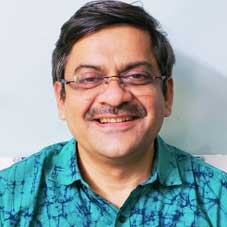
Bishwadeep Ghose
Country Director
For a Country Director, this calls for a combination of strategic thinking, field sensitivity and the ability to translate grassroots realities into scalable solutions. Bishwadeep Ghose, Country Director, Water For People India, brings this multidimensional perspective to his leadership role.
His professional journey has been shaped by curiosity, continuous learning and an ability to work across disciplines rather than follow a conventional career path.
Raised in Ranchi, in a public-sector township surrounded by nature, Bishwadeep Ghose completed his graduation in Chemistry from Hindu College, Delhi University, before pursuing an MBA in Forest Management from the Indian Institute of Forest Management, Bhopal.
He began his professional career in Gujarat, spending nearly three years working in the tribal areas of Bharuch, an experience that brought him close to grassroots development realities at an early stage of his career.
In 2007, an academic stint at the London School of Economics on political economy and international relations helped him connect years of field experience with broader theoretical frameworks and development concepts. Over time, this combination of practice and reflection shaped a systems-oriented worldview.
Today, Bishwadeep Ghose approaches water, agriculture, forests, livelihoods and development as deeply interconnected challenges. This interdisciplinary understanding continues to guide his leadership at Water For People India, where he is focused on building sustainable, inclusive and resilient WASH systems at scale.
What key lessons from your earlier roles continue to shape your leadership today?
My earliest work with tribal communities in Gujarat taught me that development begins with unlearning. Academic know -ledge alone cannot replace an under standing of local realities, and solutions cannot be imposed through predetermined templates.
Through nearly three decades of work spanning participatory forest and irrigation management, sustainable agriculture and groundwater management, I have also learned two important lessons: community participation is imperative when managing commons and the design
principles for scaling decentralised approaches need to be carefully thought through, particularly in large-scale government programmes.
How has Water For People India's 'Everyone Forever' approach evolved?
When I joined Water For People in 2020, 'Everyone Forever' already provided a powerful foundation for our work. 'Everyone' represents universal access, while 'Forever' emphasises ensuring services remain sustain able beyond individual projects.
While achieving the 'Everyone' milestones was comparatively easier, achieving the 'Forever' milestones proved more elusive because the factors influencing sustainability were systemic. This necessitated working with system actors right from project inception through to the exit stage.
In India, we subsequently set an ambition to contribute toward quality and sustain able services for around 100 million people, recognising that we could never achieve such scale alone. This required stronger partnerships with governments, communities and markets.
We also expanded across different geographies and themes, recognising that the way people interact with water is highly contextual.
Our approach has consequently evolved beyond conventional WASH interventions toward WASH-plus-water-resource-manage-ment, system strengthening and sustainable service-delivery models that can work at a much larger scale.
We also work extensively on behaviour change across various levels, recognising it as a key driver of long-term sustain ability.
How are you building stronger partner-ships for sustainable WASH services?
Our approach is rooted in trust, collaboration and collective action. Instead of designing projects independently and involving government later we increasingly co-create inter -ventions with district administrations from the beginning.
This helps identify communities with the greatest needs while also enabling convergence with existing government schemes, resources and personnel.
We deliberately work with frontline functionaries already embedded within government systems rather than creating parallel project structures that disappear when funding ends. We also bring departments, civil society organisations and other stake holders around common data and a shared under standing of the problem.
This helps establish clearer responsibilities while leaving behind stronger people, capacities, processes and institutions. Of course, bringing diverse actors together, building trust and sustaining such collaboration is easier said than done. It requires continuous engagement and an
How has Water For People India's 'Everyone Forever' approach evolved?
When I joined Water For People in 2020, 'Everyone Forever' already provided a powerful foundation for our work. 'Everyone' represents universal access, while 'Forever' emphasises ensuring services remain sustain able beyond individual projects.
While achieving the 'Everyone' milestones was comparatively easier, achieving the 'Forever' milestones proved more elusive because the factors influencing sustainability were systemic. This necessitated working with system actors right from project inception through to the exit stage.
Bishwadeep Ghose transforms grass roots insights into systems level solutions, championing collaborative leadership for Sustainable, inclusive and resilient water security
In India, we subsequently set an ambition to contribute toward quality and sustain able services for around 100 million people, recognising that we could never achieve such scale alone. This required stronger partnerships with governments, communities and markets.
We also expanded across different geographies and themes, recognising that the way people interact with water is highly contextual.
Our approach has consequently evolved beyond conventional WASH interventions toward WASH-plus-water-resource-manage-ment, system strengthening and sustainable service-delivery models that can work at a much larger scale.
We also work extensively on behaviour change across various levels, recognising it as a key driver of long-term sustain ability.
How are you building stronger partner-ships for sustainable WASH services?
Our approach is rooted in trust, collaboration and collective action. Instead of designing projects independently and involving government later we increasingly co-create inter -ventions with district administrations from the beginning.
This helps identify communities with the greatest needs while also enabling convergence with existing government schemes, resources and personnel.
We deliberately work with frontline functionaries already embedded within government systems rather than creating parallel project structures that disappear when funding ends. We also bring departments, civil society organisations and other stake holders around common data and a shared under standing of the problem.
This helps establish clearer responsibilities while leaving behind stronger people, capacities, processes and institutions. Of course, bringing diverse actors together, building trust and sustaining such collaboration is easier said than done. It requires continuous engagement and an
acknowledgement of the realities and complexities within existing systems.
What trends and opportunities will shape the future of India's WASH sector?
Climate change, groundwater stress and technology will significantly influence the sector. Groundwater is closely connected with agriculture, so drinking-water security cannot be addressed without considering agricultural water demand and farmers’ livelihoods.
The nexus between water, energy, food and ecosystems is well understood today. Designing more proof-of-concepts that view water as a 'system', and demonstrating these approaches at scale, can help address some of the tradeoffs involved over the long term.
Technology and AI can help communities better understand and manage their resources when solutions are context-specific. Sanitation also presents an important opportunity as septic tanks increasingly require safe emptying, treatment and disposal.
We are exploring circular-economy models that convert treated faecal sludge into products such as vermicom post. Approaches based on circular-economy principles can connect sanitation, agriculture, livelihoods and local enterprise while creating both environmental and economic value and generating employment.
What long-term impact do you hope to create at Water For People India?
Water and sanitation challenges are like climbing mountains: every summit reveals another peak. Building toilets creates the need for faecal-sludge management; providing household taps creates future requirements around wastewater and infrastructure maintenance. Therefore, I want us to help build responsive systems capable of anticipating and addressing new challenges rather than repeatedly rein -venting solutions.
We hope to demonstrate community-owned, market based and strengthened public-service models that governments and other actors can replicate. We also hope to unravel insights from our work across diverse climate contexts—from climate hotspots in Bihar, Assam and West Bengal, particularly the Sundarbans in the East, to the water-scarce areas of Maharashtra in the West.
These experiences can deepen our under standing of how resilient water and sanitation systems need to respond to very different ecological and community realities.
Bishwadeep Ghose, Country Director, Water For People India
Bishwadeep Ghose is Country Director of Water For People India, bringing extensive experience across water security, agriculture, forestry and development.
An alumnus of Hindu College and the Indian Institute of Forest Management, he has worked extensively with governments, communities and development institutions, championing collaborative, scalable and sustainable approaches to WASH.