

EU and South Korea Strengthen Trade and Defence Ties at Summit
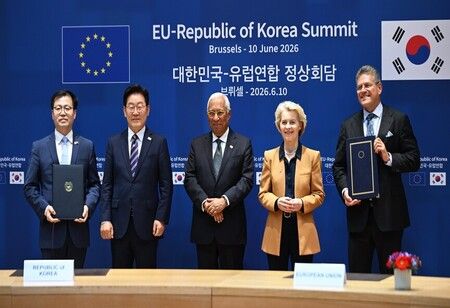
European Commission President Ursula von der Leyen, European Council President Antonio Costa, and South Korean President Lee Jae-myung commemorated the signing of a new digital trade agreement during a ceremony in Brussels.
The occasion was the 11th summit between the EU and South Korea, covering topics ranging from security and defense to trade.
“Korea is among Europe’s closest allies in the Indo-Pacific area and internationally,” stated von der Leyen. “In an unpredictable world today, reliable and trustworthy alliances such as ours are more valuable than ever.”
The three issued a combined statement praising the importance of the discussions and pledging both parties to a solid and amicable partnership.
"We reiterate our mutual dedication to effective multilateralism and to a stable, predictable, rules-based, free, and fair economic system," the statement declares.
Both parties aim to diversify their trade ties amid increasing tensions with China and the US, and the EU-South Korea digital trade pact arrives over a decade after a significant free trade agreement.
Trade between the EU and South Korea has increased twofold since 2015, with goods trade expected to hit around €124.25 billion in 2025, as per data from the European Commission.
Also Read: Sinch Names Jonas Dahlberg Acting CEO
“The European Union-Korea Free Trade Agreement continues to be one of the European Union’s most effective trade deals since it was implemented in 2011,” stated European Council President António Costa on Wednesday.
South Korea is emerging as a vital investor in Europe, especially in key areas like batteries, electric vehicles, and semiconductors.
A primary goal for the EU is to ensure the stability of semiconductor supply chains while encouraging additional investment from Korean firms in Europe.
Also Read: CG Hospitality, Marriott International Enhance Long-Term Partnership
An EU official stated, “Korea holds a global leadership role in semiconductors.” "This is evidently a domain with substantial prospects for collaboration that would advantage both parties."
The digital trade pact finalized on Wednesday is anticipated to enhance the wider trade partnership by minimizing “unneeded obstacles to digital trade” and offering increased “legal clarity” for companies functioning in both markets, as stated by another EU representative. It will enable international data exchanges while banning the compulsory transfer of source code.
The agreement aims to create strong online consumer protection regulations, although both parties plan to uphold their individual standards for personal data and privacy protection.
Economic security was prominently featured on the summit agenda, with both parties agreeing to initiate a high-level dialogue focused on supply chain resilience.
Also Read: India Looks to Expand Venezuela Oil Cooperation
Last year, supply chains faced strain due to China's export limitations on strategic materials, such as rare earths vital for green technologies and defense, along with items related to the chip industry, crucial for automotive production.