

How Hyundai i20 and Kia Carens Clavis Reflect Different Buyer Priorities
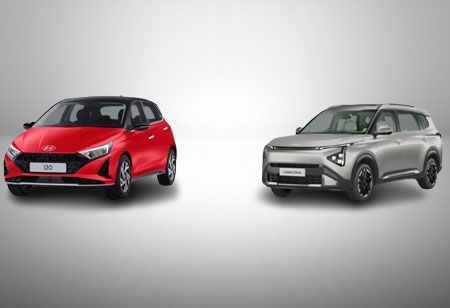 The Indian automotive market today is shaped by diverse buyer priorities. While some consumers seek a compact, stylish car for everyday driving, others prioritise space, comfort, and versatility for family use. The Hyundai i20 and the Kia Carens Clavis represent these contrasting priorities, offering two distinct interpretations of what a modern car should deliver.
Rather than competing directly, they cater to different expectations—one focused on personal driving experience, the other on shared mobility.
Compact Priorities: Urban Driving and Personal Comfort
The Hyundai i20 is designed for individual drivers and small households. Its compact dimensions—3,995 mm in length with a 2,580 mm wheelbase—make it well-suited for city environments.
This size advantage translates into:
- Easier manoeuvrability in traffic
- Better parking convenience
- Lower effort in daily commuting
The i20’s design also reflects a focus on personal expression. Some of the highlights of i20 are its “mesmerising grille, signature DRLs, and sporty styling”, emphasising its visual appeal.
For buyers prioritising individuality and ease of use, these characteristics are highly relevant.
Family Priorities: Space and Versatility
In contrast, the Kia Carens Clavis is built to accommodate larger groups and varied travel needs. With a length of approximately 4,550 mm and a wheelbase of 2,780 mm, it offers significantly more interior space.
Its 6- and 7-seater configurations further reinforce its role as a family-oriented vehicle.
Key features supporting this include:
- Three-row seating with flexible configurations
- Split and reclining seats for added comfort
- Roof-mounted air vents for rear passengers
These elements make it suitable for long journeys and multi-passenger travel, reflecting a priority on shared comfort rather than individual convenience.
Driving Experience: Engagement vs Stability
The i20 is designed to offer an engaging driving experience. It comes with a 1.2L petrol engine delivering up to 88 PS, along with manual and IVT transmission options.
Features such as:
- Drive modes (Normal and Sport)
- Compact chassis for responsive handling
enhance its appeal for drivers who enjoy being behind the wheel.
The Carens Clavis, on the other hand, prioritises stability and comfort. It offers multiple engine options, including turbocharged petrol and diesel variants with higher torque outputs, designed to handle heavier loads and long-distance travel.
This reflects a shift in focus—from driving enjoyment to passenger comfort.
Interior Experience: Driver-Centric vs Passenger-Centric
Inside the cabin, the difference in priorities becomes more evident.
The Hyundai i20 offers a driver-focused interior, featuring:
- Dual-tone cabin with ambient lighting
- Digital cluster with TFT display
- Compact yet spacious layout for front occupants
The emphasis is on creating a comfortable and engaging space for the driver.
In contrast, the Carens Clavis adopts a passenger-centric approach. It includes:
- Three-row seating with ample legroom
- Flexible seat configurations for different needs
- Large cabin designed for group travel
This ensures comfort is distributed evenly among all occupants, not just the driver.
Technology: Smart Features vs Comprehensive Systems
Both vehicles offer modern technology, but their scopes differ.
The i20 integrates features such as:
- 10.25-inch touchscreen infotainment system
- Bluelink connected car technology with 60+ features
- Wireless charging and voice recognition
These features enhance everyday convenience.
The Carens Clavis, however, provides a broader technology ecosystem:
- Dual panoramic display panels
- Level 2 ADAS with multiple driver assistance features
- 360-degree camera and advanced safety systems
This reflects its role as a vehicle designed for longer journeys and multiple users.
Safety: Standard vs Expanded Coverage
Safety is a priority for both vehicles, but their implementation varies.
The i20 offers 6 airbags as standard, along with ESC, VSM, and hill-start assist, providing a strong safety baseline.
The Carens Clavis expands on this with:
- ADAS Level 2 features
- All-wheel disc brakes and advanced collision avoidance systems
This broader safety package aligns with its family-oriented positioning.
Buyer Priorities: Personal vs Shared Value
Ultimately, the choice between these two vehicles reflects different buyer priorities:
- Buyers choosing the Hyundai i20 prioritise compact size, driving comfort, and personal convenience
- Buyers choosing the Kia Carens Clavis prioritise space, versatility, and family usability
These priorities influence not just the type of vehicle chosen, but also how it is used.
The Role of Digital Comparison
Online car-buying platforms such as ACKO Drive allow buyers to compare vehicles based on their intended usage before booking online. By evaluating factors such as seating capacity, features, and performance, users can determine which vehicle aligns with their priorities.
This helps shift the decision-making process from comparison to suitability.
Conclusion
The Hyundai i20 and Kia Carens Clavis clearly reflect two different sets of buyer priorities. One is designed for individual mobility and urban convenience, while the other focuses on family comfort and long-distance versatility.
As the automotive market continues to evolve, such distinctions are becoming more pronounced. Buyers are no longer choosing the “best” car—they are choosing the one that best fits their lifestyle.