

How to Choose the Right MCCB for Industrial Applications
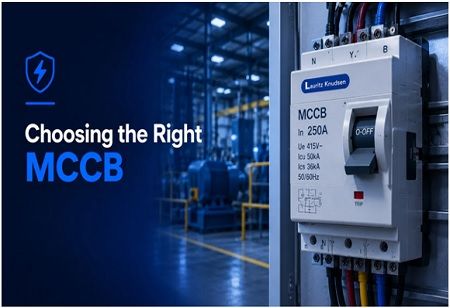 Choosing the right circuit breaker for a factory floor is not a small decision. Get it wrong, and you risk nuisance tripping. Or worse, a breaker that fails when a real fault hits. This is exactly why understanding the moulded case circuit breaker matters so much. Poor protection-device selection can contribute significantly to electrical failures and downtime in industrial facilities. Choosing the correct breaker is therefore an important part of an effective protection strategy.
People don't realise that a breaker used for industrial protection must match load type, fault current, and ambient conditions. Precisely. This article walks through what an MCCB actually is. Why it matters. And how to pick the right one.
What is an MCCB
An MCCB, short for moulded case circuit breaker, protects circuits against overload and short-circuit faults. Depending on the model, MCCBs fitted with electronic trip units may also provide adjustable earth-fault protection.
Unlike a standard MCB, it handles much higher current ratings. Often well beyond a hundred amps. Think about this: a single electrical MCCB installed at a distribution panel can protect an entire production line. It cuts power the instant a fault occurs. Inside the moulded casing sits a trip mechanism, calibrated contacts, and an arc extinguishing chamber. That construction lets the device interrupt heavy fault currents safely, without the enclosure itself catching fire. For industrial settings, this level of protection is not optional. It is fundamental.
Importance of MCCBs in Industrial Applications
Why do industrial facilities depend so heavily on MCCBs? Because the stakes are higher. A single fault on a factory floor can damage expensive machinery. Halt production. Injure workers nearby. A properly rated MCCB breaker responds fast enough to prevent that escalation, protecting both equipment and people at once.
Protecting Heavy Machinery from Overload
Industrial machinery draws far more current than office equipment. Motors, compressors, and conveyor systems create inrush currents at startup. Currents that would trip an ordinary breaker instantly. A correctly sized electrical MCCB tolerates that inrush while still tripping fast during a genuine overload. For example, a rolling mill motor might draw six times its rated current for a few seconds at startup. The right breaker rides through that surge without nuisance tripping. Yet it still protects the motor windings from sustained overheating.
Preventing Downtime from Electrical Faults
Unplanned downtime costs far more than the price of a breaker. Every minute a production line sits idle adds up. A reliable MCCB breaker isolates a faulty section of the circuit quickly, without shutting down the entire facility. That selective coordination helps maintain service continuity by isolating only the affected section of the electrical system whenever practical. A well-coordinated protection scheme, using breakers rated correctly at each level, keeps a single fault from cascading into a plant-wide shutdown.
Safety for Personnel and Equipment
Beyond equipment protection, an MCCB also protects the people working around it. A properly selected MCCB helps reduce fault-clearing time and can significantly limit arc-flash incident energy, improving both personnel safety and equipment protection. Appropriate protection settings also help the breaker respond correctly to overload and short-circuit conditions.
Industrial environments carry a higher risk simply because of the current levels involved. A breaker chosen with the correct thermal and magnetic settings responds appropriately to slow overloads and sudden short circuits alike, keeping personnel safe during abnormal conditions.
Choosing the right MCCB for industrial applications means balancing several factors together. Not picking a number off a datasheet. Getting even one factor wrong undermines the entire protection scheme. From current rating to breaking capacity, each decision shapes how well the moulded case circuit breaker performs once installed in a live industrial environment.
Factors to Consider While Choosing the Right MCCB for Industries
Choosing the right MCCB for industrial applications means balancing several factors together. Not picking a number off a datasheet. Getting even one factor wrong undermines the entire protection scheme. From current rating to breaking capacity, each decision shapes how well the moulded case circuit breaker performs once installed in a live industrial environment.
Determining the Correct Rating
Getting the MCCB rating right starts with an accurate load calculation. Undersize it, and the breaker trips constantly under normal load. Oversize it, and it fails to protect the circuit during an actual fault. Engineers typically calculate the maximum continuous load current and select an MCCB with an appropriate rating in accordance with applicable standards, load characteristics, coordination requirements, and future expansion where applicable.
Breaking Capacity and Fault Level
Every MCCB for industrial applications must handle the maximum fault current the installation could realistically produce. Breaking capacity, expressed as ultimate breaking capacity (Icu) and service breaking capacity (Ics) in kiloamps (kA), indicates the maximum prospective short-circuit current the MCCB can interrupt safely. Selecting adequate breaking capacity is essential for reliable fault protection.
Industrial sites with large transformers or multiple generators often produce higher fault levels than a typical commercial building. Choosing a breaker with insufficient breaking capacity risks catastrophic failure during a real fault. Not a clean, controlled trip.
Trip Settings and Selective Coordination
Modern breakers allow adjustable thermal and magnetic trip settings. Getting these right prevents unnecessary shutdowns. Think about this: if every breaker in a facility trips at the same threshold, a single fault could shut down far more of the plant than necessary. Proper selective coordination ensures that the protective device nearest to the fault operates first, minimizing disruption to the remainder of the electrical system while maintaining continuity of service wherever possible. That isolates the smallest possible section. This kind of planning takes experience, but it pays off during an actual fault event.
Environmental and Enclosure Considerations
Industrial environments are rarely clean or climate-controlled. Dust, moisture, vibration, and temperature swings all affect breaker performance over time. An MCCB rating that works fine in a controlled panel room might underperform in a foundry or a chemical plant. Selecting an appropriate enclosure with suitable IP or NEMA protection, depending on the installation environment, helps ensure long-term reliability. Choosing equipment designed for the expected levels of dust, moisture, vibration, and temperature also improves service life. Skipping this is one of the more common and costly mistakes made during industrial electrical design.
Compliance with Applicable Standards
Industrial MCCBs should comply with recognised standards such as IEC 60947-2 or the applicable national equivalent. Compliance confirms that the breaker has been tested for performance, interrupting capacity, protection characteristics, and operational reliability under defined conditions. Selecting certified equipment helps ensure the protection system performs as intended and meets industry and regulatory requirements.
Conclusion
Choosing the right breaker is not a formality. It is a core engineering decision. One that affects safety, uptime, and equipment life. A well-selected electrical MCCB accounts for load current, prospective short-circuit current, breaking capacity, ambient operating conditions, selective coordination, and compliance with applicable standards. Get these factors wrong, and even a well-built breaker underperforms when it matters most.
For industrial facilities that need dependable protection, Lauritz Knudsen Electrical & Automation manufactures breakers engineered to handle demanding conditions reliably. Working with a qualified electrical engineer during selection, rather than guessing at a rating, remains the safest path forward. Get this decision right, and you protect your equipment, your people, and your production schedule for years to come.