

Modi and Tusk Push for Doubling of Indo-Polish Trade
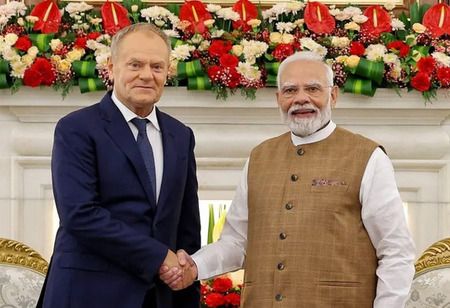
India and Poland aimed to double their bilateral trade by 2030 and agreed to enhance collaboration in defense, emerging technologies, critical minerals, and connectivity after discussions between Prime Minister Narendra Modi and Polish Prime Minister Donald Tusk.
In a collective statement released following their meeting, the leaders reinforced their dedication to transforming the India-Poland Strategic Partnership into tangible, timely, and mutually advantageous results. They additionally suggested a Defense Industry Discussion and consented to conduct a dialogue on counter-terrorism.
The Prime Minister of Poland is in India on an official visit from October 21 to 23, joined by a high-ranking delegation consisting of about 100 top CEOs and industry leaders.
The leaders assessed developments since PM Modi’s trip to Poland in August 2024, when the bilateral relationship was upgraded to a Strategic Partnership and the Action Plan for 2024–2028 was established.
They approved the mid-term review of the plan carried out by External Affairs Minister S. Jaishankar and Polish Deputy Prime Minister and Foreign Minister Radosław Sikorski in Warsaw in September.
Regarding economic cooperation, PM Modi encouraged Polish businesses to increase their investments and activities in India, highlighting its market potential, skilled labor, and the expanding manufacturing and innovation environment. Polish Prime Minister Tusk emphasized Poland's position as a portal for Indian companies looking to enter Central and Eastern Europe and the broader European market.
Also Read: Tamil Nadu Reconstitutes TNRERA and Names K Phanindra Reddy
The leaders appreciated the India-Poland Business Forum that took place during the visit and promoted collaborations in industrial machinery, defense, infrastructure, pharmaceuticals, mining, essential minerals, energy, and information and communication technologies. They also consented to reactivate the bilateral working group on agriculture to enhance trade and collaboration.
Both parties urged for the prompt signing and ratification of the India-European Union Free Trade Agreement and its timely execution to facilitate market access, encourage investment, and fortify essential value chains.
Acknowledging the importance of digital technologies in development and public service provision, the leaders decided to engage in joint research in artificial intelligence, semiconductors, and quantum technologies, while enhancing partnerships with startups and connections between research organizations and companies.
Also Read: Client Associates Appoints Ritwick Ghoshal and Pulkit Vashishth
Defense collaboration was a key element in the conversations. The leaders expressed satisfaction with the results of the eighth Joint Working Group on Defense meeting that took place in Warsaw in September and concurred to continue consistent communication between their defense institutions.
The suggested Defense Industry Dialogue aims to promote business involvement and investigate commercially promising collaborations in technology, co-development, co-production, and other types of industrial partnerships, where there is mutual agreement. Both parties also conveyed optimism that a deal on the reciprocal safeguarding and sharing of classified information would be finalized shortly. They recognized cybersecurity, defense innovation, and critical and emerging technologies as fields for enhanced collaboration.
In space, the leaders promoted enhanced collaboration between institutions and industries to pinpoint particular joint initiatives. They also emphasized prospects in battery recycling, rare earth mineral processing, geology, and mining. Discussions are ongoing for a memorandum of understanding concerning geology, mining, and essential minerals.
Also Read: Force Motors Partners With Rosmerta for Vehicle Scrapping
The leaders remembered the historical connections established when India provided refuge to thousands of Polish women and children during World War II. They embraced both instances of the Jam Saheb Memorial Youth Exchange Programme, with the most recent taking place in October 2026, and remembered Poland’s support for over 2,000 Indian students trapped in Ukraine during Operation Ganga.
Regarding global matters, India and Poland advocated for structural changes in the United Nations, which include enlarging the Security Council in both permanent and non-permanent categories. Poland voiced its support for India's inclusion in a reformed and larger Council and reaffirmed its endorsement of India's bid for a non-permanent seat for 2028–29.