

Who Moved My Cheese?

Anand Ramakrishnan, CEO, Qtek Systems
The answer to the above question from the famous book by Spencer Johnson will soon be Automation! Although I have been in IT for more than two decades, I have never witnessed a frenzy quite like the one we are witnessing today on automation. This focus on automation is across industries. Most conversations invariably veer towards automation and how humans will soon be left with no jobs. Driverless cars, customer service bots, drones for delivery, robots in manufacturing; you name it, automation is on to the extent that even a panipuri (a popular Indian street food) vendor’s role is being automated! Most of these automation solutions will also self-learn and hence will get better at what they do over time.
What’s more; most automation decisions are based on favourable RoI. CEOs across industries are setting aside a budget for implementing automation and incorporating expected returns into the business plan. Automation strategies are discussed by Board Members, which underlines its strategic importance. Since automation is now irreversible, the biggest questions will be ‘Will it result in human employability slowdown?’, ‘Is automation and human employment a zero sum game?’. The answer is an emphatic NO. In my view, the automation and human worlds go hand-in-hand and one elevates the other. The challenge is to get the best of both worlds.
Let us consider a simple example that all of us can relate to An irate customer calls a Call Center to complain about a faulty product she purchased. Let us see the difference between a bot and a human.
A bot would start with a pre programmed greeting followed by a set of options, asking her to choose. Once she chooses, it would probably get into the next set of options, and so on. By the time she finishes her interaction, she is probably looking to replace the faulty product with one from competition. On the other hand, a human would first know that the customer is irate, either through her tone, mannerism or expressions. The agent can sense the situation and gets straight to the point of promising a replacement or a refund. If the customer is mollified and happy at the end of the call, instinctively, the agent may decide to sell her some additional services as well.
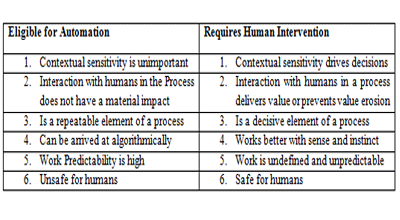
Therefore, in any process that is being considered for automation, it is important to understand the juxtaposition of the human element with automation in the process. This can be determined through a few simple guidelines:
An example is in medicine. Strides in automation have resulted in usage of AI to evaluate outcomes of maxillo facial surgery without the patient being touched. Usage of wearables has ensured doctors can continuously monitor essential parameters of their patients, which would otherwise require an attendant to measure these parameters at periodic intervals. Once automation is used for all the preliminaries, it is still a human doctor who analyzes the results and performs the surgery. Don’t we feel a lot better the moment a doctor touches us? The doctor’s human touch can never be replaced by a stainless steel arm of a robot touching us, even if it can do a billion permutations a second for better diagnosis! Hence, the ideal situation is when the machine calculates and the doctor interprets & works on the patient.
Let’s take another example of a shopper using an AI based application that enables her to visualize herself in the dresses she has liked. It saves a lot of effort and time, which would have otherwise been spent on physically trying out each of the dresses. This may even result in the shopper buying more in the same visit, since she has the time and it is easy for her to choose the dresses she wants. However, equally important is the saleswoman who is able to speak to her about the fabric, the fitting, the matching accessories and any other question the shopper may have. Putting the two worlds together provides the best customer experience possible for the shopper. I am sure in our everyday lives, we will find many such examples where humans and automation will work together to make our lives better. Such applications are plenty in industries such as Banking, Healthcare, Energy Management, Retail and so on.
The key is to look at automation as an extension of humans rather than as a replacement. Automation will ensure elevation of human competencies, since we will be able to do away with mundane jobs and focus on value creation, which will only help us do our jobs better. Yes, automation can move the cheese; but we need to ensure humans work together with automation to discover a newer and better way of finding more cheese.
An example is in medicine. Strides in automation have resulted in usage of AI to evaluate outcomes of maxillo facial surgery without the patient being touched. Usage of wearables has ensured doctors can continuously monitor essential parameters of their patients, which would otherwise require an attendant to measure these parameters at periodic intervals. Once automation is used for all the preliminaries, it is still a human doctor who analyzes the results and performs the surgery. Don’t we feel a lot better the moment a doctor touches us? The doctor’s human touch can never be replaced by a stainless steel arm of a robot touching us, even if it can do a billion permutations a second for better diagnosis! Hence, the ideal situation is when the machine calculates and the doctor interprets & works on the patient.
In any process that is being considered for automation, it is important to understand the juxtaposition of the human element with automation in the process
Let’s take another example of a shopper using an AI based application that enables her to visualize herself in the dresses she has liked. It saves a lot of effort and time, which would have otherwise been spent on physically trying out each of the dresses. This may even result in the shopper buying more in the same visit, since she has the time and it is easy for her to choose the dresses she wants. However, equally important is the saleswoman who is able to speak to her about the fabric, the fitting, the matching accessories and any other question the shopper may have. Putting the two worlds together provides the best customer experience possible for the shopper. I am sure in our everyday lives, we will find many such examples where humans and automation will work together to make our lives better. Such applications are plenty in industries such as Banking, Healthcare, Energy Management, Retail and so on.
The key is to look at automation as an extension of humans rather than as a replacement. Automation will ensure elevation of human competencies, since we will be able to do away with mundane jobs and focus on value creation, which will only help us do our jobs better. Yes, automation can move the cheese; but we need to ensure humans work together with automation to discover a newer and better way of finding more cheese.