

India-US Trade Deal: 18 Percent US Tariff on ‘Made in India’ Products
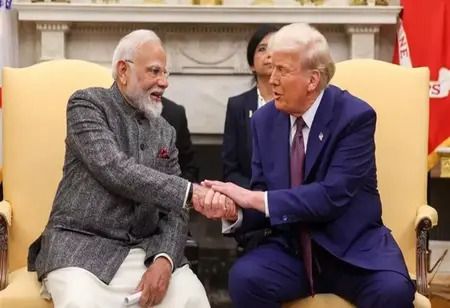
US President Donald Trump revealed a trade agreement with India that reduces US tariffs on Indian imports from 50 percent to 18 percent, contingent upon India stopping its purchases of Russian oil and easing trade restrictions.
Trump revealed the agreement on social media after a conversation with Indian Prime Minister Narendra Modi, highlighting that India would now purchase oil from the US and possibly Venezuela.
Also Read: ixigo Trains Renews Partnership with Rohit Sharma
"Due to friendship and respect for Prime Minister Modi and at his request, we have reached a Trade Agreement between the US and India, effective immediately, which will see the US reduce the Reciprocal Tariff from 25 percent to 18 percent," Trump stated on his social media site Truth Social.
He stated that PM Modi has pledged India to "PURCHASE AMERICAN at a significantly increased level," along with acquiring over $500 billion in US energy, such as coal, plus technology, agricultural, and other goods. "Trump mentioned that India will also advance to eliminate their Tariffs and Non Tariff Barriers towards the United States, to ZERO."
Also Read: MeitY Seeks Industry Views on Fast-Tracking DPDP Act Rollout
Before Trump's return to office and the increase of US tariff rates to double-digit figures last year, India maintained some of the highest tariffs globally, with a straightforward applied rate of 15.6 percent and an effective applied tariff of 8.2 percent, based on World Trade Organization data.
"A significant milestone. Under PM Modi's leadership, India continues to strengthen its economic footprint and emerge as a global growth magnet. Stronger India–US ties will continue to drive growth, propel innovation, boost investment, and strengthen prospects of job creation, thereby reinforcing global confidence in Made in India," said former Union Minister Smriti Irani.
Leading US and Indian business advocacy groups hailed President Donald Trump's announcement of a breakthrough in US-India trade relations, calling the reduction of tariffs on Indian goods from 50 percent to 18 percent a "historic first step".
Since the imposition of tariffs by Washington, Indian markets have experienced significant decline, resulting in it being the lowest performing market in comparison to other emerging nations in 2025. This has led to unprecedented levels of foreign investor outflows. The announcement led to a surge in the US-listed stocks of prominent Indian companies. For example, Infosys, a leading IT consulting firm, saw a rise of 3.53 percent in its share price during afternoon trading. Wipro, a renowned consultancy, experienced a seven percent increase, while HDFC Bank's shares gained 3.4 percent.
Also Read: AEPC Chairman Urges Centre to Introduce Focus Market Scheme
Additionally, the iShares MSCI India exchange-traded fund saw a notable rally of 3.3 percent. It has been indicated by India's high commissioner to Canada that Prime Minister Mark Carney is scheduled to travel to India in the near future. This visit is aimed at exploring new trading relationships, a necessity exacerbated by the current trade tensions instigated by the trade policies of President Trump.
Carney's visit comes in the wake of a mutual pledge by the two leaders to initiate discussions aimed at establishing a novel trade agreement known as the Comprehensive Economic Partnership Agreement (CEPA). This announcement was made during their meeting at the G20 Summit in South Africa in November of last year.
After months of intense trade discussions between the world's top two democratic nations, an agreement has finally been reached. In an attempt to influence New Delhi to halt its purchases of Russian oil, President Trump decided to increase tariffs on imports from India to 50 percent last August. Recently, he hinted that these tariffs may be raised further if India does not comply with his demands.