

Lok Sabha Passes Railway Grants, Vaishnaw Highlights Allocation
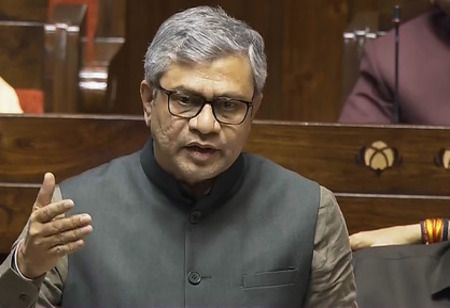
The Lok Sabha approved the budgetary allocations for the Railways for the fiscal year 2026–27 after a comprehensive two-day deliberation in which more than 210 Members of Parliament actively engaged.
As a result, Members of Parliament expressed the need for the implementation of Vande Bharat train services to stops within their electoral districts, the revival of train services that were halted during the pandemic, and the reinstatement of discounts for elderly passengers and other groups.
Also Read: BHIM Payments App Names Mahendra Singh Dhoni as Brand Ambassador
In response to the dialogue, Vaishnaw offered a detailed ten-point rebuttal addressing various aspects of railway infrastructure, passenger amenities, safety protocols, and job creation.
The Minister stated that the consolidation of the railway budget into the general budget has greatly enhanced the financial standing of the sector.
Previously, the annual budget allocations for railway projects were approximately between Rs.24,000 and Rs.25,000 crore, occasionally reaching up to around Rs.30,000 crore. In contrast, the current funding has significantly surged to approximately Rs.2,72,000 crore.
The structure has also facilitated the ability to make decisions, such as authorizing new projects, implementing train services, granting stoppages, and integrating technology, on a continuous basis rather than being limited to the annual railway budget. He further stated that the railway sector has been granted an unprecedented budgetary allocation of Rs 2,78,000 crore for the fiscal year 2026-27, with the aim of promoting growth and progress in various regions.
The Minister indicated that there has been a noticeable enhancement in the financial stability of the railways over the course of the past ten years. In regards to expenses, he disclosed that the most significant cost is related to employee salaries, amounting to approximately Rs.1,19,000 crore, followed by energy expenses of about Rs.32,000 crore, financing costs of around Rs.23,000 crore, and pension obligations of nearly Rs.64,000 crore.
Also Read: Cadence Names Dr. Alok Jain as Managing Director for India
He mentioned that the implementation of electrification and the transition from diesel to electricity have resulted in savings of approximately Rs.6,000 crore.
Despite these investments, the railway system is presently operating at a small surplus, with a continued emphasis on enhancing safety measures, passenger services, and upgrading amenities for travelers.
The minister announced that the Eastern Dedicated Freight Corridor has been successfully completed, signaling significant progress in infrastructure development. He observed that progress on the project was stagnant before 2014. However, as of now, approximately 2,800 kilometers of the freight corridor have been successfully constructed, with about 480 trains running on it every day.
Furthermore, he made reference to advancements in the development of the Ahmedabad-Mumbai high-speed train project, highlighting that over 350 kilometers of infrastructure has already been constructed. Additionally, the minister emphasized that station redevelopment continues to be a primary area of focus. Vaishnaw acknowledged that a total of 180 stations have been successfully finalized, with close to 500 currently in the process of being constructed at advanced stages.
Also Read: Former WPP and Dentsu Executive Anita Kotwani Joins Zoo Media
The Minister discussed advancements in safety measures and technology implementation, highlighting the installation of the Kavach safety system on 3,000 kilometers of railway tracks. Additionally, efforts are currently underway to expand this system to cover a total of 20,000 kilometers. Around 80 percent of the railway lines have already been enhanced to accommodate speeds of up to 110 kilometers per hour.