

The Rising Cost of the Canada-US Trade War: Tariffs Reshaping Cross-Border Trade
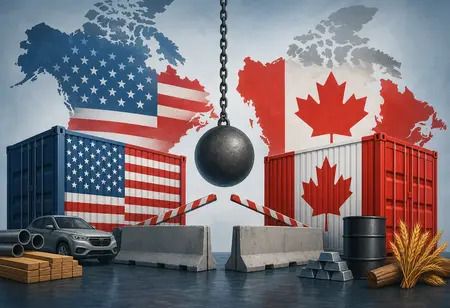
As Canada-US trade war reshapes one of the world’s most integrated trading relationships, businesses are facing rising cross-border trade costs, supply-chain disruptions, and greater uncertainty in long-term planning. The article highlights the impact of tariffs, trade policy, supply-chain resilience, and market diversification, while examining how manufacturers, exporters, small businesses, and consumers are navigating the evolving trade environment and adapting to a more uncertain North American economy.
Canada and the United States have long shared one of the world’s most deeply integrated trading relationships, with businesses on both sides relying on the movement of goods, components, raw materials and finished products across the border. This interdependence has made cross-border trade a foundation of North American manufacturing and commerce, but it also means changes in trade policy can quickly affect supply chains, operating costs and investment decisions.
The latest trade war between the two nations and tariff measures are putting that relationship under growing pressure. Canada has introduced counter-tariffs on US goods worth about $27.6 billion, while Washington has imposed additional restrictions on selected Canadian imports, including dairy products, alcoholic beverages and motor vehicles. Although both governments have framed their measures around reciprocity and market access, the economic consequences extend beyond the products directly covered by the tariffs.
For manufacturers, exporters and retailers, the dispute is creating a more complex cost environment as companies reassess supply chains and sourcing strategies. Higher cross-border costs, changing market conditions and shifting trade rules are forcing businesses to balance efficiency with resilience.
Canada’s Tariff Countermove Raises Trade Tensions
Canada's latest response is directly linked to the US decision to impose a 50% tariff on about $27.6 billion worth of Canadian goods under Section 338 of the Tariff Act of 1930.
Canada's Department of Finance said the countermeasures would match the corresponding US rates and cover products originating in the United States. The tariff list spans multiple industries, including steel and aluminium, dairy products, household appliances, agricultural equipment, pulp and paper, plastics and electronics.
For Canadian businesses importing US products, the duties increase the landed cost of goods even when the underlying product price remains unchanged. Importers can absorb the additional expense, renegotiate contracts, change suppliers or pass some of the increase on to customers.
Canada has also announced financial support for businesses and workers affected by the tariffs. The federal government said it was introducing $7.5 billion in new and enhanced measures, including an additional $1.5 billion through the Regional Tariff Response Initiative to help small and medium-sized enterprises manage tariff-related pressures.
Such measures can provide temporary relief, but businesses must still reassess supplier relationships, pricing structures and market opportunities as the trade environment evolves.
Also Read: The Next Phase of U.S. AI Leadership: From Innovation to Responsibility
Washington Businesses Face Higher Export Costs
From the US perspective, the dispute is centered partly on what the Trump administration describes as discriminatory Canadian trade policies.
Washington has argued that Canadian tariff-rate quota arrangements for dairy products disadvantage US producers. It has also criticized Canadian restrictions affecting US alcoholic beverages and aspects of Canada's motor vehicle tariff system.
The White House has used Section 338 as the legal basis for additional duties and import restrictions. The administration temporarily suspended the new duties in August after Canada expressed a commitment to address the issues, but the suspension lasted only three days.
The White House subsequently said Canada had not fulfilled the commitment and allowed the measures to take effect on August 22. On September 8, Washington announced import exclusions affecting certain Canadian dairy products, alcoholic beverages and motor vehicles. According to the White House, the selected products will be excluded from US imports from September 29, while other Canadian products remain subject to additional duties.
For US companies selling into Canada, Canadian counter-tariffs can make affected products more expensive for buyers. A Canadian distributor may respond by seeking domestic suppliers, negotiating lower prices with a US exporter or exploring suppliers in Europe, Asia and other markets.
Smaller exporters can face greater pressure because they generally have fewer markets across which to distribute higher costs.
Supply Chains Brace for Cross-Border Disruptions Due to the Trade War
The broader impact of the dispute lies in the complexity of North American supply chains. Canada and the United States have developed closely connected manufacturing networks spanning automotive, agriculture, energy, metals, food processing and consumer products. Components can cross the border multiple times before a finished product reaches its final customer.
A tariff introduced at one point in the supply chain can therefore have a cumulative effect.
The automotive industry provides a clear example. Vehicle manufacturers and suppliers depend on cross-border flows of engines, electrical systems, metals and other components. Changes to tariffs or eligibility rules can force companies to revisit sourcing arrangements that were built around relatively stable North American trade.
Industrial manufacturers face similar challenges. A US company importing specialized Canadian material may encounter higher costs when the product becomes subject to an additional duty. Switching suppliers may then involve longer delivery times, qualification expenses or differences in quality and specifications.
These considerations can influence investment decisions even before companies experience the full financial impact of the tariffs. Executives need greater visibility into future costs when committing capital to factories, equipment, inventories and long-term supplier agreements.
The changing rules also add administrative complexity. Companies must monitor tariff classifications, country-of-origin requirements, customs documentation and exemptions, while legal and compliance teams may need to assess whether individual products fall under revised tariff schedules.
Small Businesses and Consumers Feel the Trade War’s Ripple Effects
Large multinational companies often have greater capacity to redesign supply chains or negotiate with suppliers, while small and medium-sized businesses may have fewer alternatives.
Canadian business groups have warned that the latest counter-tariffs affect smaller firms more directly than some earlier measures that focused heavily on major commodities and industrial sectors.
Dan Kelly, president of the Canadian Federation of Independent Business, says, “The latest measures are affecting small and medium-sized business owners across Canada, describing many of them as being in a difficult position as the dispute expands.”
The issue is particularly significant for companies that import finished products or specialized inputs from the United States. Smaller businesses may lack the purchasing power needed to secure substantial price concessions from suppliers.
Consumers can ultimately feel the impact as well.
When importers face higher duties, they can absorb the cost, reduce margins, renegotiate with suppliers or increase prices. Where costs are passed through the supply chain, tariffs on imported components can raise the production cost of finished goods, while duties on consumer products can make them more expensive in Canadian stores.
Border communities are also exposed because local economies often depend on cross-border customers and trade. Declining visits or spending can affect retailers, restaurants, logistics providers, wholesalers and other businesses that rely on cross-border activity.
The economic consequences therefore extend beyond major corporations and national trade statistics, reaching businesses and consumers at the local level.
Also Read: US Tariffs on India an Economic Boon?
Tariffs Add Pressure to Business Planning
The effect of tariffs goes beyond the immediate duty charged on an imported product. Businesses must also account for potential changes in demand, investment, inventory and sourcing.
Higher prices can weaken demand where customers have access to alternatives. Companies may postpone expansion decisions while assessing the direction of trade policy, while procurement teams may begin evaluating new suppliers even when existing relationships remain operational.
Inventory management can become particularly challenging when tariff changes are announced with limited notice. Businesses may increase inventories before new duties take effect, providing temporary protection against higher costs. However, this approach also ties up working capital and can create additional storage expenses.
Logistics providers and customs brokers face their own operational challenges as companies adapt to changes in tariff classifications, documentation and product eligibility.
For businesses operating on tight margins, the combined effect of these costs can be significant.
Diversification Emerges as Businesses Seek Stability to counter Trade War Impact
As the Canada-US trade war continues, diversification is becoming a more important element of corporate strategy.
For Canadian companies, this can involve expanding exports beyond the United States. For US businesses, it can mean identifying suppliers outside Canada or developing additional markets for products that have historically depended on Canadian demand.
Canada's efforts to deepen economic relationships with other partners illustrate this shift. Prime Minister Mark Carney has been pursuing closer cooperation with the European Union in areas including energy, critical minerals, artificial intelligence and financial services. On September 17, the EU offered Canada a pathway toward becoming its first associate member, although the proposed status still requires further discussion and does not represent full EU membership.
For businesses, however, diversification is not an immediate substitute for the US market. North America's geography, infrastructure and decades of commercial integration mean companies cannot simply replace one trading relationship with another.
Instead, diversification is likely to involve gradually developing additional markets and supplier relationships while maintaining established North American operations.
Companies may increasingly adopt a multi-source approach, ensuring that they have alternatives if tariffs, trade restrictions or other disruptions affect established supply channels.
The Cost of Waiting for Certainty
The most difficult issue for many businesses may be the unpredictability of trade policy itself.
Tariff lists can change, with some products removed from earlier measures and others added. Companies therefore have to make decisions based not only on current rates but also on the possibility of future adjustments.
That complicates long-term contracts and procurement planning. A manufacturer negotiating a three-year supply agreement needs to assess whether importing a particular component will remain commercially viable. Similarly, a retailer purchasing inventory must consider whether tariff changes could affect costs before the goods reach the market.
For smaller businesses, these decisions can be especially challenging because they have fewer resources for legal, customs and supply-chain analysis.
The result is a shift in procurement priorities. Companies that once selected suppliers primarily on price may increasingly consider geographic diversification, delivery reliability, tariff exposure and the ability to switch suppliers when conditions change.
Also Read: How US–China Tariffs Are Disrupting Textile Trade
A Cross-Border Relationship under Pressure
For businesses, the impact extends beyond the additional duty on individual shipments. It influences sourcing decisions, pricing strategies, inventory planning, investment and long-term supply-chain design.
Cross-border trade can no longer be planned solely around the assumption of stable tariff conditions. Companies must increasingly factor policy developments into decisions that were traditionally driven by cost, demand and logistics.
As businesses on both sides of the border reassess their exposure, supply-chain flexibility and visibility are becoming increasingly important. Developing alternative suppliers and markets can strengthen resilience, but the depth of Canada-US economic integration means the two countries will remain closely connected.
For companies, the cost of the trade dispute is therefore measured not only in tariffs but also in the resources required to adapt to a trading environment where policy changes can reshape long-term business decisions.