

Cabinet Approves Rs.5,070 Crore for Floating Solar Power Plants
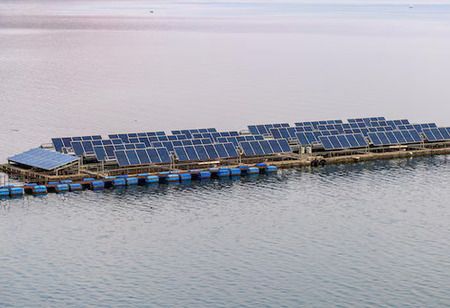
The Union Cabinet, led by Prime Minister Narendra Modi, endorsed the Pradhan Mantri Surya Sarovar Yojana (PM-SSY), a fresh Rs.5,070-crore initiative designed to increase floating solar power projects throughout India.
India presently possesses approximately 700 MW of floating solar capacity.
Also Read: BHEL Bags Order for Gas Turbines from Nigeria's Dangote Refinery
The initiative will aid in the creation of 5,000 megawatts (MW) of floating solar photovoltaic (FSPV) capacity alongside energy storage systems, assisting the nation in boosting clean energy production without requiring more land.
The initiative will support 5,000 MW of floating solar installations paired with energy storage systems that can hold electricity for a minimum of two hours, or a total storage capacity of 10,000 megawatt-hours (MWh).
Projects will be approved between FY2026-27 and FY2030-31, and financial support will be provided until FY2032-33. The choice comes after an evaluation by the National Institute of Solar Energy (NISE), which calculated that India's reservoirs and various inland water bodies possess a floating solar capacity of approximately 102.18 gigawatt-peak (GWp).
Eligible projects will get Central Financial Assistance (CFA) of Rs.1 crore per MW upon successful commissioning under the scheme.
Also Read: FDA Halts Food Permits of Cricket Club of India, MIG in Mumbai
Moreover, developers may obtain as much as Rs.50 lakh for each project to conduct necessary preliminary studies before construction begins. These encompass bathymetric and hydrographic surveys, environmental evaluations, and various technical studies that assist in minimizing project risks. The government stated that the initiative will help every state and Union Territory.
The Cabinet's approval arrives as India persists in growing its solar energy capacity at an unprecedented rate.
The Ministry of New & Renewable Energy reports that India surpassed the United States in yearly solar capacity installations in 2025, establishing itself as the second-largest growth market globally after China.
India's solar industry has grown swiftly in recent years. After reaching 50 GW of installed solar capacity in 2022, the nation added another 50 GW in just three years. It subsequently increased its capacity by an additional 50 GW within merely 14 months, from January 2025 to March 2026, bringing the overall installed solar capacity to 154 GW by April 2026.
In FY26, India installed 44.61 GW of additional solar capacity, surpassing the government's goal of 34 GW. The increase was also almost twice the former yearly record of 23.83 GW set in FY25.
Also Read: GMR Aero Technic Partners Honeywell Aerospace for MRO Services
India intends to establish 500 GW of renewable energy capacity by 2030. By April 2026, roughly 50 percent of the nation's total installed power capacity of 288 GW was generated from non-fossil fuel sources. This consists of 56 GW from wind energy, 51 GW from large hydroelectric power, 8.8 GW from nuclear energy, over 11 GW from biomass, and 5 GW from small hydroelectric sources.